
Torres del Paine O Circuit: A Practical Guide to the Full Loop
Our trip report from seven days of hiking the whole circuit: the backside, the John Gardner Pass, costs, food and booking.
In February 2025, my partner and I spent 9 days in Torres del Paine in Chilean Patagonia, seven of them hiking the full O Circuit and two resting. We had booked five months in advance and still could not get every campsite.
This post is not a strict day-by-day itinerary. It is a breakdown of the logistical decisions that let us walk the whole loop anyway, what our experience was like, where to buy food along the trail, and whether the O is worth the extra days over the W.
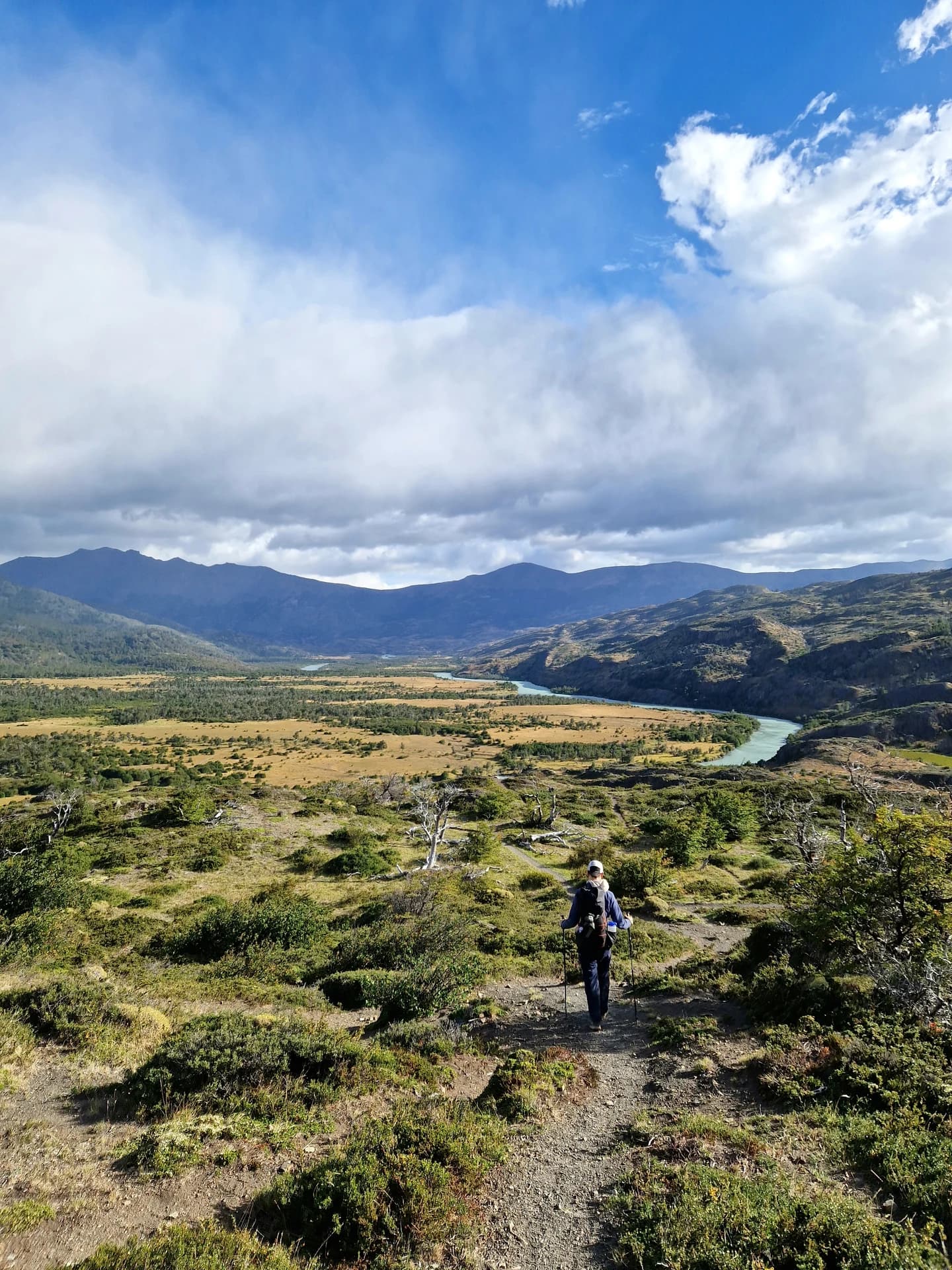
The trail above the Río Paine on the first day of the O Circuit
The O Circuit: quick facts
- Route: A full loop counter-clockwise around the Paine Massif: Central → Serón → Dickson → Los Perros → John Gardner Pass → Grey → Paine Grande → French Valley → Los Cuernos → Chileno → Base Torres → Central.
- Distance: over the full loop, with around of total ascent.
- Duration: 7 to 9 hiking days (we hiked 7, with 2 rest days).
- Highest point: John Gardner Pass at around .
- Direction: Counter-clockwise, enforced by the rangers on the backside.
- Campsites: Two operators, Vértice (Paine Grande, Grey, Dickson, Los Perros) and Las Torres (Central, Serón, Chileno, Francés, Los Cuernos). You book each separately. Wild camping is not allowed.
- Best time: November to March. We went in February.
- Guide required? No. The O Circuit is well marked and straightforward to hike independently.
Booking the O Circuit (and What to Do When It's Full)
Campsites on the O Circuit are run by two separate companies, and you have to book both. Vértice operates Paine Grande, Grey, Dickson and Los Perros, and Las Torres operates Central, Serón, Chileno, Francés and Los Cuernos. Reservations open several months before the season and the popular high-season dates disappear within weeks . We booked about five months out and still could not get everything. Rather than give up on the full loop, we made two adjustments.
Adjustment one: combining the first two stages. Serón, our first night, was full. So instead of camping inside the park on the first night, we stayed near the main entrance, started very early the next morning, and combined the first two stages into a single day of about 32 km, reaching Camping Dickson after roughly ten hours of hiking. It was a demanding first day but perfectly manageable with an early start, and Dickson turned out to be one of the most beautifully located campsites on the whole circuit, so the effort was well worth it.
Adjustment two: the French Valley without a campsite. Later, on the W section, there was no availability at the French Valley campsites (Italiano and Francés). Instead we based ourselves an extra night at Paine Grande and hiked the French Valley as an out-and-back to Mirador Británico, returning to Paine Grande. That took us around eight hours and was my favourite section on the W side of the circuit.
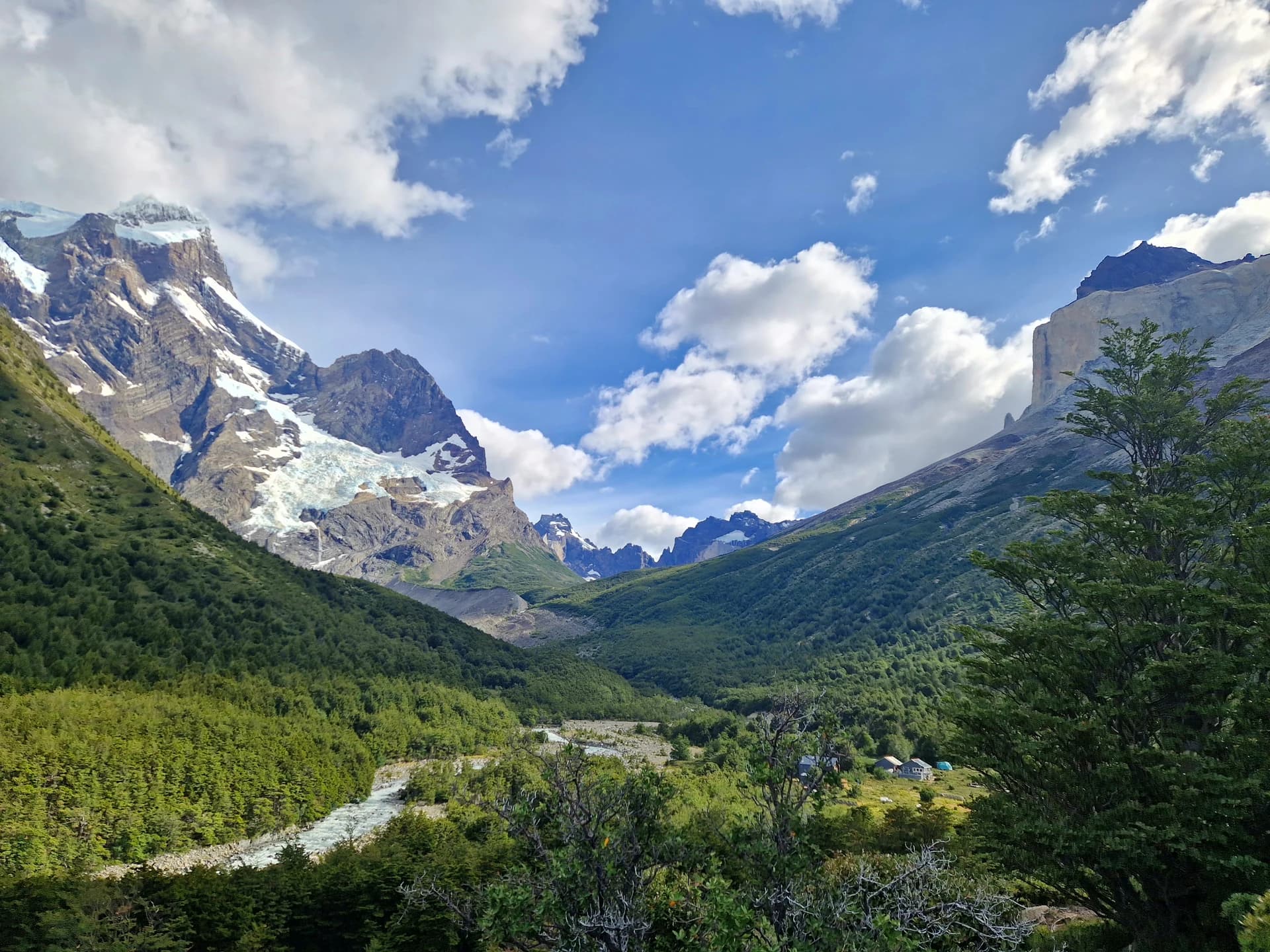
Looking into the French Valley with the hanging glacier on the side of Paine Grande
The Camping Pehoé workaround. From Paine Grande we took the catamaran across Lake Pehoé to Pudeto and stayed at Camping Pehoé ( per person, and no reservation required). This turned out to be an excellent move. It is cheaper than the Las Torres campsites we had been trying to book on the W (around per person), almost always has space, and has a surprisingly good and affordable restaurant where a main was about . We even stayed a second night, because from Camping Pehoé you get what is, in my opinion, the best panoramic view of the Paine Massif across the lake, one of the most photographed scenes in the park after the Towers themselves.
The next morning we found a ride back into the park with other campers heading in for the day, which is easy since many people use Pehoé as a base for day trips. From the entrance we hiked to the Towers and back in around seven hours before catching the evening bus to Puerto Natales.
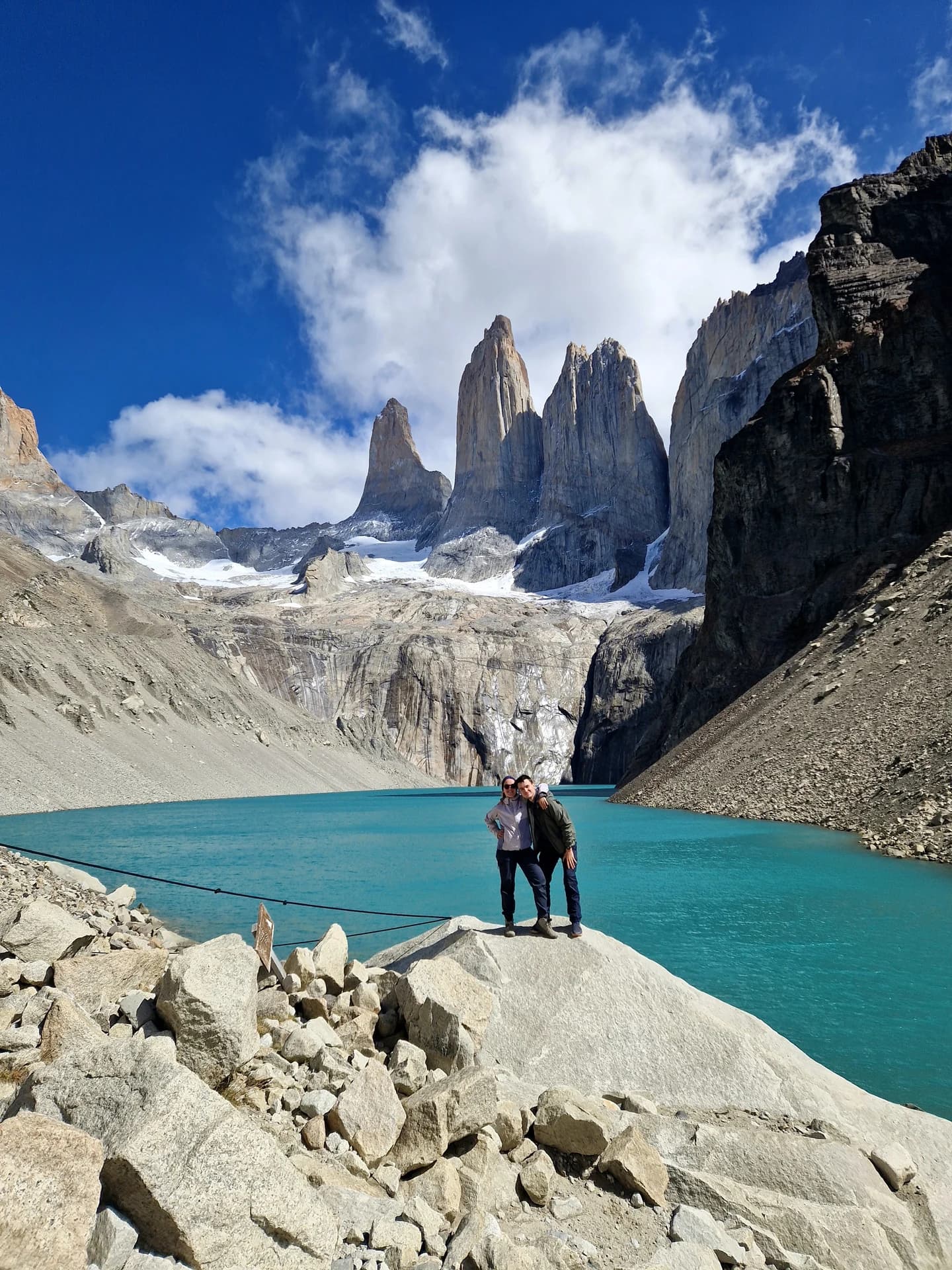
The three granite towers above the glacial lake at Mirador Base Torres
One last practical note. Before the Towers hike you can pay to store your luggage at reception, or use the free storage room that is open to everyone. We used the free option and everything was exactly where we left it, but since that room is not secured, whether you pay for the official storage is a personal call.
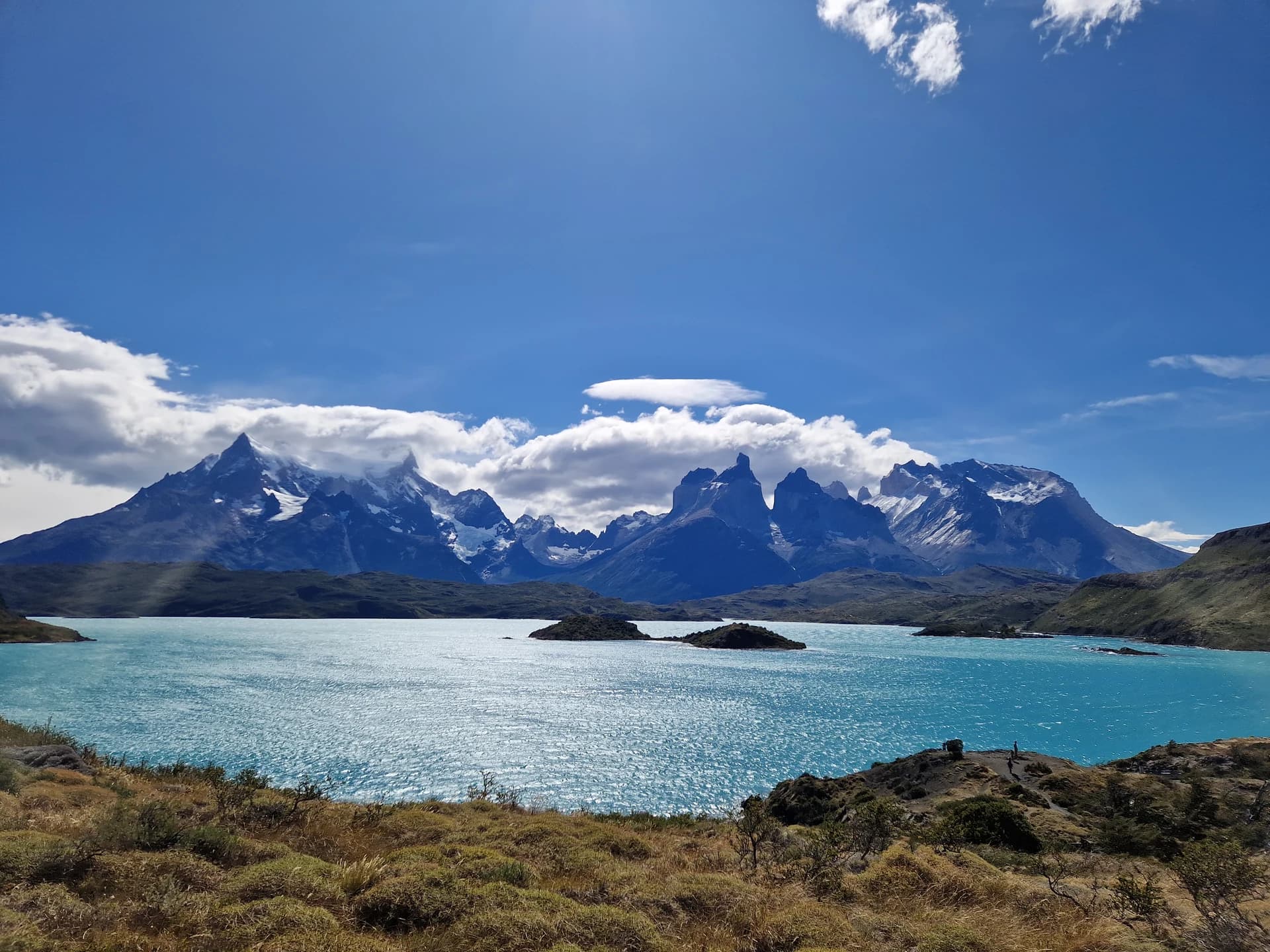
The Cuernos del Paine seen across the turquoise water of Lake Pehoé from Camping Pehoé
The Backside of the O Circuit
The backside is the part of the loop that the W Trek doesn't cover, running from the eastern trailhead around the north of the massif to Grey. It is quieter and more varied than the W, and it builds towards the John Gardner Pass. The full loop is walked counter-clockwise and the rangers enforce this, so you hike the backside first and cross the pass before joining the W.
Serón and the open pampa. Leaving the eastern trailhead, the trail runs gently through open Patagonian steppe along the Río Paine. It is easy walking through grassland, with the back of the massif off to one side. Camp Serón sits in a green meadow, and it is usually windy.
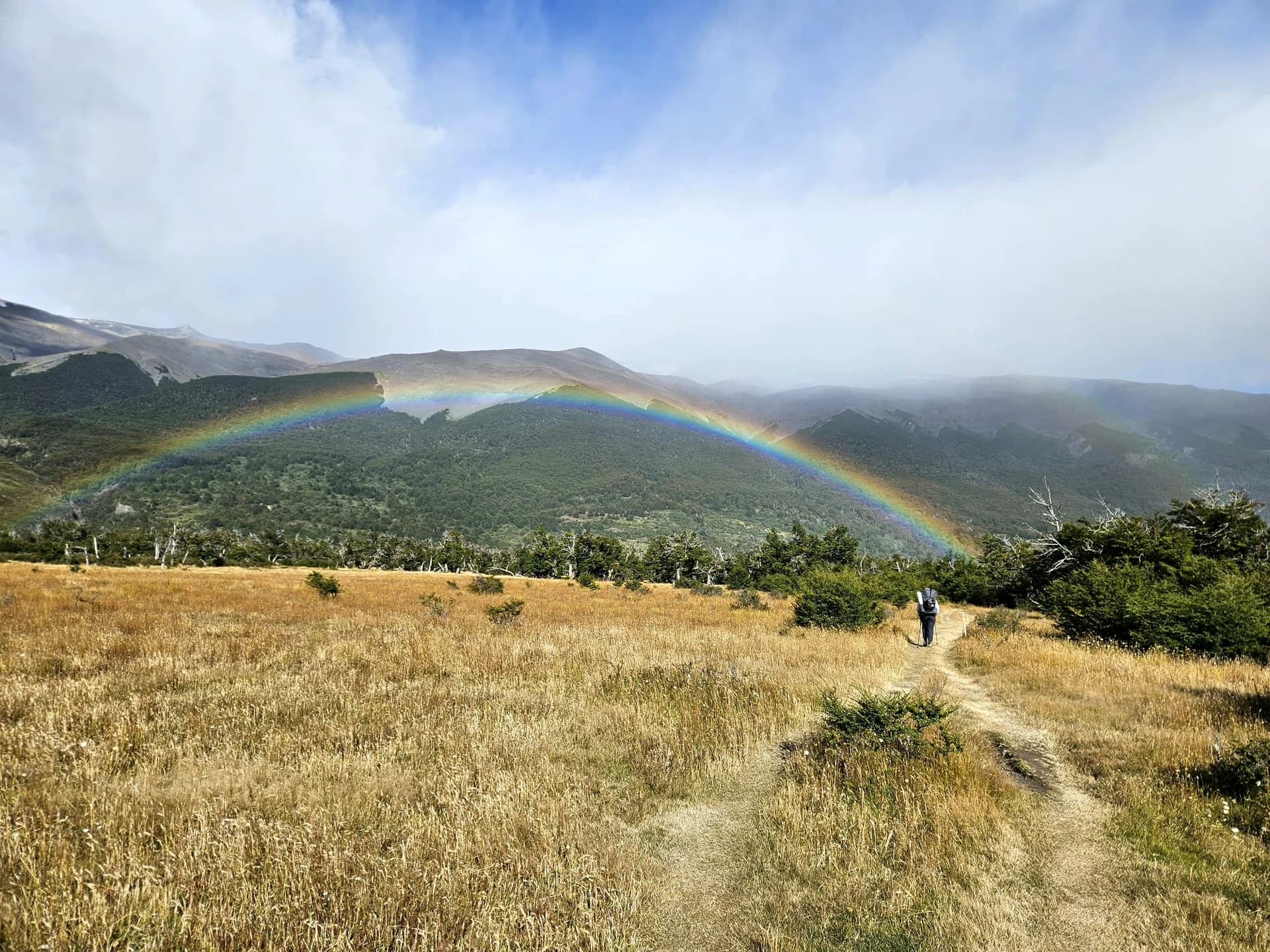
A rainbow over the open pampa on the way to Camp Serón
Toward Dickson. The path climbs to an exposed shoulder above Lago Paine before dropping toward Lago Dickson. The first sight of the lake, milky blue with the Dickson Glacier behind it and the campsite on a green flat at the water's edge, was one of the prettiest arrivals on the whole circuit. It is also one of the windiest sections, so we were glad we had started early.
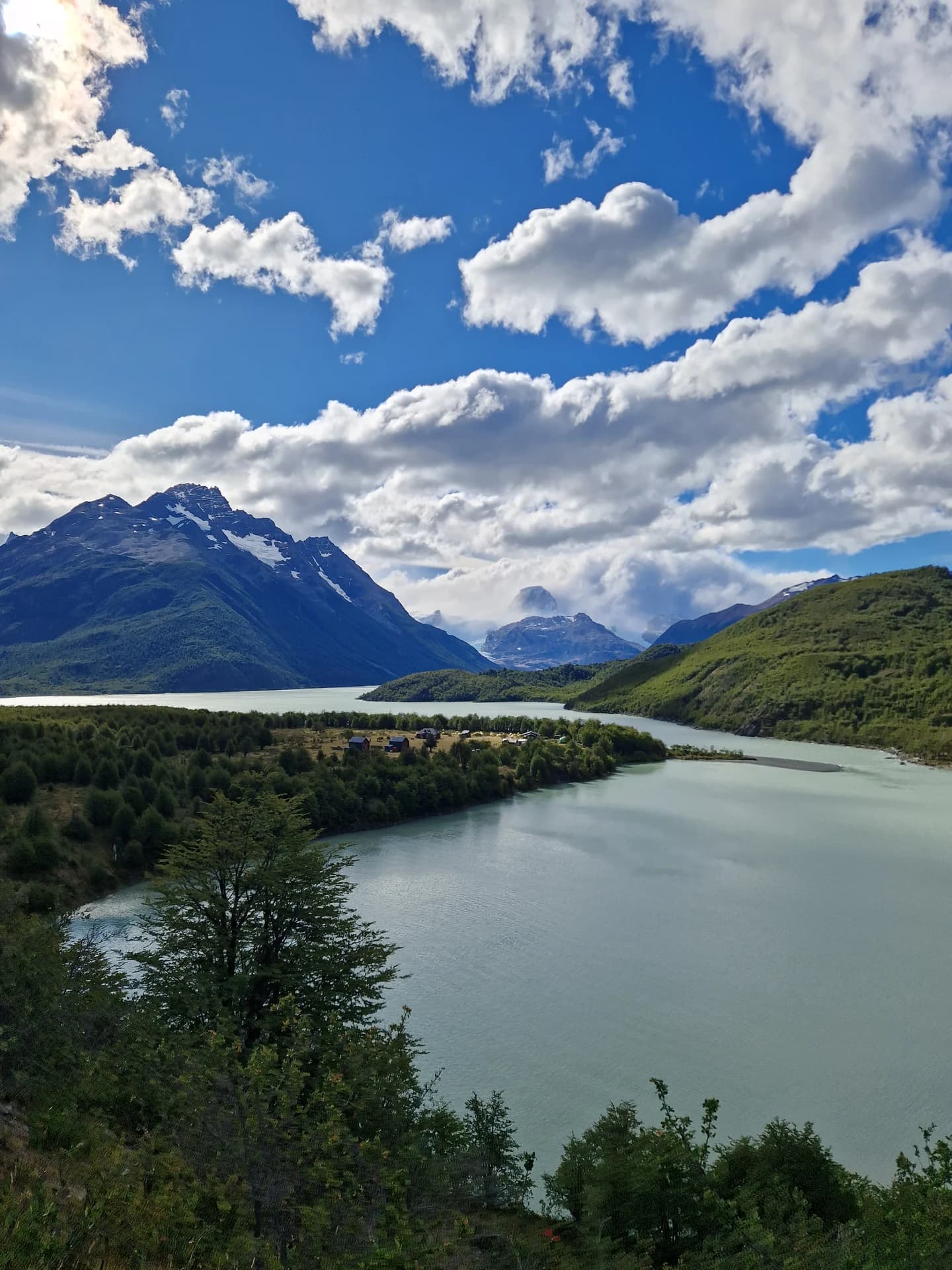
Lago Dickson with Camping Dickson on the far shore and the mountains behind
Into the forest to Los Perros. From Dickson the trail turns up the valley of the Río de los Perros and into beech forest, gaining height slowly over boggy ground with a lot of roots. Los Perros is a basic forested campsite near its own glacier, with a grey lagoon below it and small icebergs in the water. It can get cold, and since everyone has to be out before 7:00 the next morning, most people go to bed early.
John Gardner Pass. This is the longest and hardest day of the loop, and the rangers make everyone leave Los Perros before 7:00 in the morning so there is enough time to get over the pass and down to Grey. You start in the dark, climb through the last of the forest and come out above the treeline on the bare, windy slope up to the pass, the high point of the circuit at around 1,200 metres. Rangers can also close the crossing altogether when the weather is bad. From the top you look out over the Southern Patagonian Ice Field, with Grey Glacier stretching away below you. The descent to Grey is long and steep, with a few ladders and suspension bridges near the bottom, and the glacier stays in view almost the entire way down. We got into Camp Grey tired and very happy with the day, and from there you are back on the W.
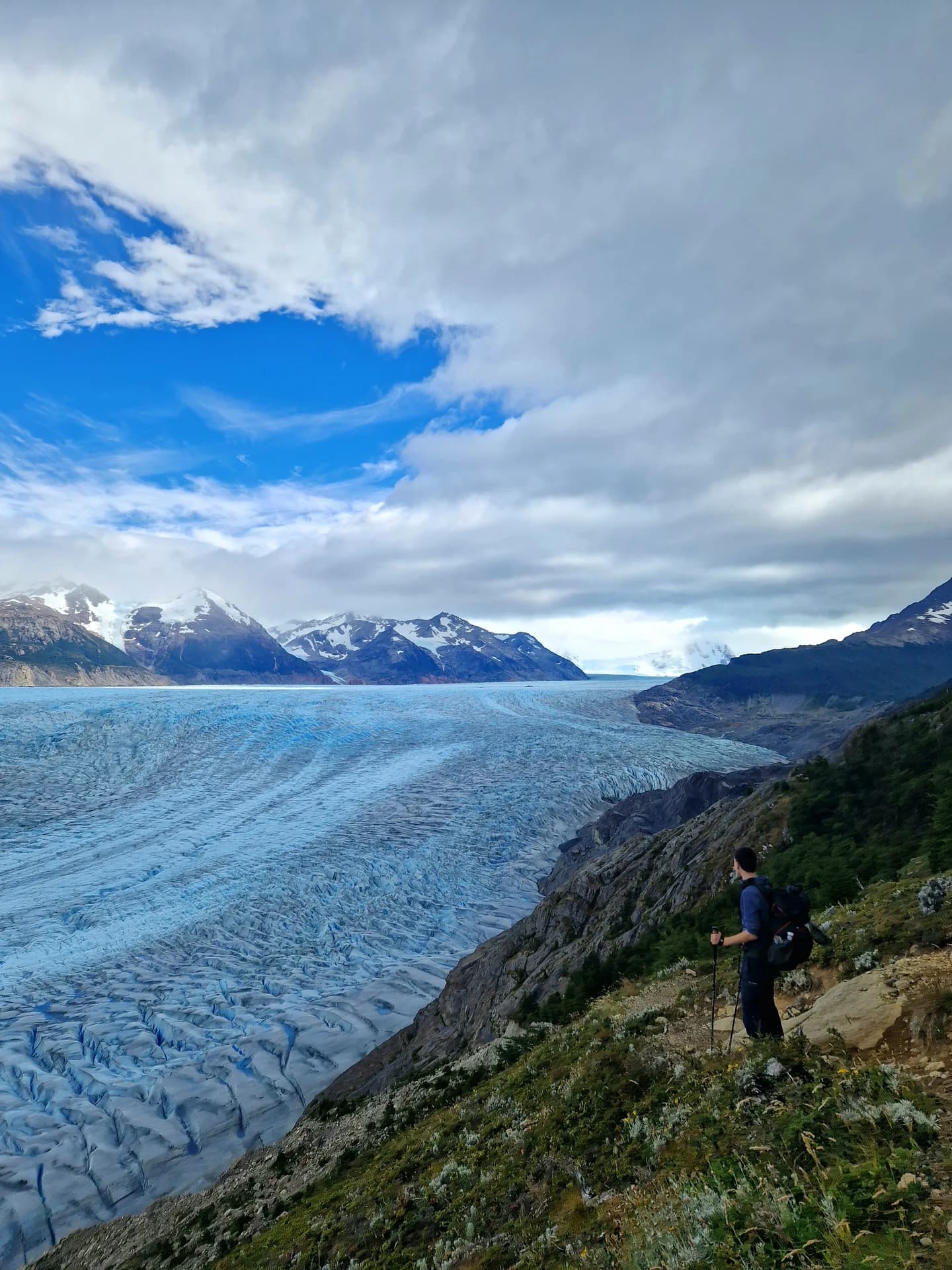
Looking out over Grey Glacier on the descent from John Gardner Pass
O Circuit vs W Trek: Which Should You Do?
The W Trek is the famous one. It makes a W shape along the southern side of the park and covers the two most famous parts, the French Valley and the Towers, usually over four to five days. The O Circuit contains the entire W and adds the remote backside, looping right around the Paine Massif over seven to nine days.
If you have the time, we would very much recommend doing the full O circuit. The French Valley was our favourite section on the W side, and the Towers are rightly iconic, but the most memorable hiking for us was on the backside. The first sections of the circuit, and the climb over John Gardner Pass to the first view of Grey Glacier, were consistently spectacular and far quieter than the W. Choose the W if you are short on days or newer to multi-day trekking. Choose the O if you want the complete, wilder version of the park.
Food and Resupply on the Trail
One thing that surprised us was how easy it is to buy food along the trail. Nearly every campsite has a small mini-market, though prices and selection vary a lot.
The Vértice campsites on the backside offered the best value. We were pleasantly surprised to find basics like packaged cheese and ham at fairly reasonable prices, around each. The shops along the W Trek also have plenty of supplies, but expect to pay at least double for similar items. If you want to reduce pack weight, it is genuinely possible to buy food as you go rather than carrying everything from the start.
The same value gap shows up in the camping itself. The Vértice sites on the backside cost around per person, while the Las Torres sites on the W run to about per person.
Gas is easy to come by as well. Some of the shops along the trail sell canisters, but many campsites also have a collection of part-used ones left behind by other hikers that you are free to use, and Paine Grande in particular had a large pile of them. It is worth checking what is already there before buying a new one, and leaving yours behind at the end for whoever comes next.
Crowds and Atmosphere
Torres del Paine is Patagonia's most famous national park and probably the most visited destination for multi-day hikers in the region, so we expected it to be busy. The only place we really noticed crowds was the day hike to the Towers, where people regularly queued on the steeper sections. Everywhere else the trail never felt overwhelmingly busy.
In fact this was by far the most social multi-day hike we did in nine months of travelling through South America. Because everyone follows the same sequence of campsites, you keep running into the same people day after day. It creates a great atmosphere and made the whole experience more enjoyable.
Costs and Practicalities
A few numbers and logistics worth knowing before you go:
- Park entrance: around for the multi-day (Circuit) ticket for foreign visitors, bought in advance online through CONAF.
- Catamaran across Lake Pehoé (Paine Grande to Pudeto): about per person, one way, cash. No reservations, you queue and board.
- Camping Pehoé: per person, no reservation needed, with a restaurant and a mini-market.
- Getting there and back: regular buses run between Puerto Natales and the park, with an evening service back to town.
- Direction and permits: the full circuit is counter-clockwise only, and you must have a booked bed or campsite for every night, since wild camping is prohibited.
Final Thoughts
Torres del Paine absolutely lived up to the hype. It is beautiful, with genuinely good infrastructure in place. It is heavily commercialised, but that is understandable given how popular it is.
If you have the time, we would recommend the full O Circuit over just the W. The French Valley was our favourite section on the W side, but the backside of the O, and especially the climb over John Gardner Pass, gave us the most memorable scenery of the entire hike. And even if you cannot secure every campsite you had planned, do not give up on the full loop. With a bit of flexibility and a few small adjustments, it is entirely possible, and in our case it turned into an unforgettable experience.
More treks in South America
We walked into Torres del Paine straight from the Dientes de Navarino on Isla Navarino, the southernmost circuit in the world, which is the opposite experience in almost every way: unmarked, unbooked and wild camping the whole route. North of the park, in Argentine Patagonia, the Huemul Circuit out of El Chaltén is a shorter but far more committing four days, with river crossings, no campsite infrastructure and a long traverse looking out over the Southern Patagonian Ice Field.
Further north, in Peru, the Huayhuash Circuit was the most demanding trek we did in South America and can also be walked without a guide, while the Salkantay Trek is a more approachable 5-day route to Machu Picchu. For something gentler, the Colca Canyon near Arequipa is a 3-day trek with thermal baths and frequent condor sightings.
Frequently asked questions
Can you hike the Torres del Paine O Circuit if some campsites are fully booked?
Often yes, with some flexibility. We booked five months ahead and still could not get every campsite, which is completely normal in Torres del Paine. We completed the full O Circuit anyway by combining two stages into one longer day when Serón was full, and by taking the catamaran across Lake Pehoé to stay at Camping Pehoé (which needs no reservation) when the French Valley campsites were booked. Wild camping is not allowed, so every night still has to be at an official campsite or refugio.
How far in advance should you book the O Circuit?
As early as you can. The campsites are run by two operators, Vértice and Las Torres, and the best dates in the December to February high season sell out within weeks of reservations opening. We booked about five months out and still missed a campsite. Book both operators as soon as the season opens, and build a little flexibility into your plan in case one night is unavailable.
Which direction do you hike the O Circuit?
Counter-clockwise. The rangers enforce this direction on the full circuit, so you hike the remote backside first (Serón, Dickson and Los Perros), cross the John Gardner Pass, and only then join the W Trek section from Grey onward.
How hard is the John Gardner Pass?
It is the toughest day of the O Circuit. Rangers require everyone to leave Los Perros campsite before 7:00 am so there is enough time to cross safely, and they can close the pass altogether in bad weather. You climb through forest and then out onto the exposed pass at around 1,200 m, then descend a long, steep slope with a few ladders down to Grey. It is not technical, but it is physically demanding and very weather dependent.
Can you buy food on the O Circuit?
Yes. Nearly every campsite has a small mini-market, so you do not need to carry all your food from the start. The Vértice campsites on the backside offer the best value, with basics like cheese and ham for around 3,000 to 4,000 CLP each, while the W-side shops charge roughly double for similar items. Buying along the way is a good way to reduce pack weight.
Do you need a guide for the O Circuit?
No. The O Circuit is well marked and can be hiked independently. You book your own campsites with Vértice and Las Torres, buy your park entrance online in advance, and follow a clear, waymarked trail. We hiked the whole loop self-guided.
How many days does the O Circuit take?
Most people take seven to nine days of hiking. The example itinerary in this post splits the loop into eight days covering 118 km. We walked it in seven by combining the first two stages into one long day, plus two rest days, for nine days in the park in total.
O Circuit or W Trek: which is better?
If you have the time, the full O Circuit is worth it. The W Trek covers the famous highlights, the French Valley and the Towers, but the backside of the O, including the John Gardner Pass and the first views of Grey Glacier, was the most memorable part for us and far less crowded. Choose the W if you are short on time or newer to multi-day trekking, and the O if you want the complete, wilder loop.