
About Tour du Mont Blanc
This iconic 170km loop circles Western Europe's highest peak, traversing alpine meadows, glacial valleys, and mountain passes across three countries. The route offers spectacular views of Mont Blanc's massive glaciated massif and connects charming mountain villages.
Tour du Mont Blanc map
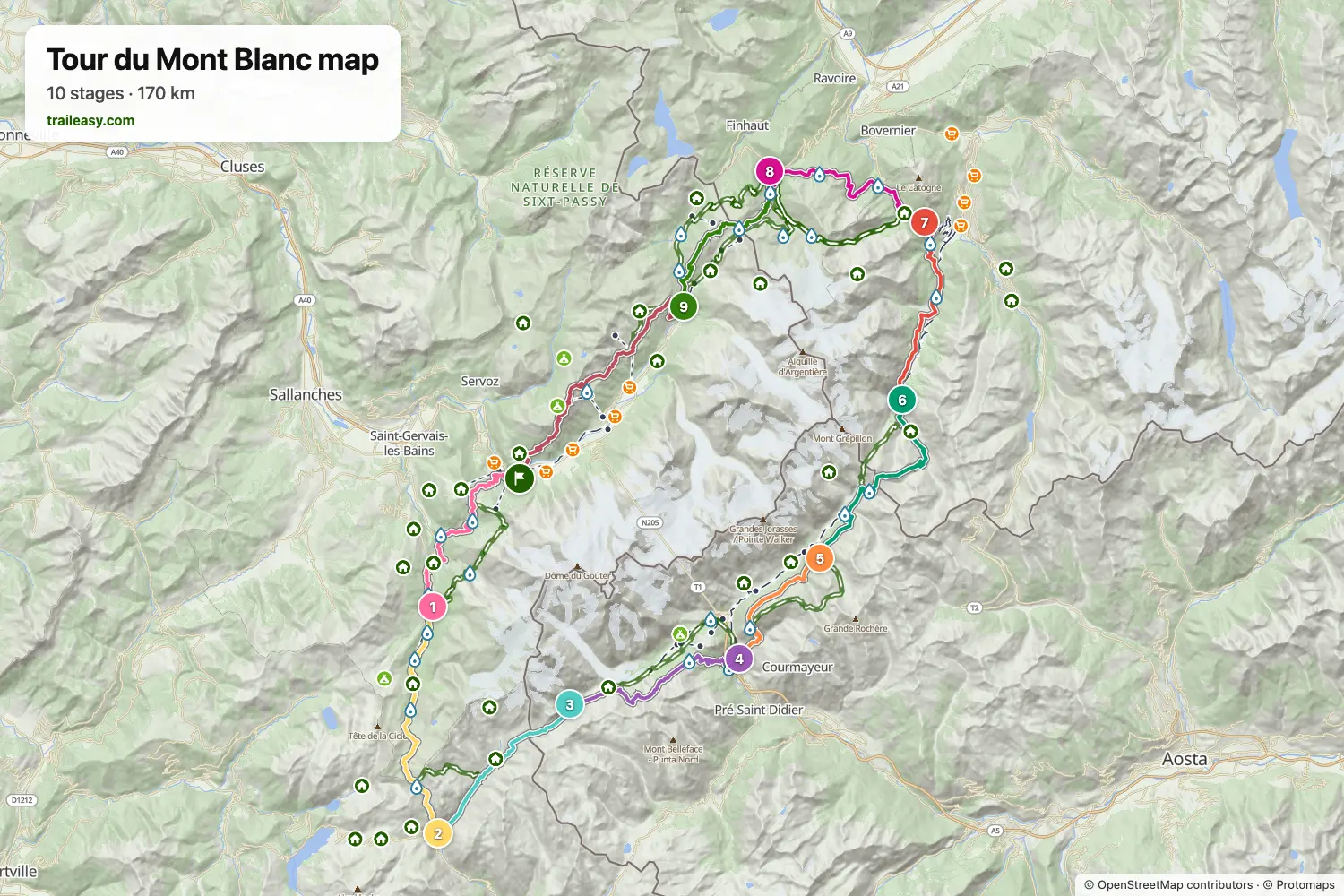
The interactive map shows the whole route, with accommodation, water and public transport along the way.
Tour du Mont Blanc route planner
Build a day-by-day itinerary in the route planner, find accommodations along the route, and download the GPX file. Start from an example below or from scratch.
10-Day ItineraryShown below
A relaxed 10-day counter-clockwise Tour du Mont Blanc circuit through France, Italy, and Switzerland. This classic route splits the Col de la Seigne crossing with a memorable night at Rifugio Elisabetta, offering stunning views of the Aiguille des Glaciers and Mont Blanc massif.
Tour du Mont Blanc in 9 Days
The Tour du Mont Blanc counter-clockwise through France, Italy and Switzerland in nine days, with the long stages split at huts along the way: Rifugio Elisabetta below Col de la Seigne, Rifugio Bertone above Courmayeur and Alpage de la Peule past Grand Col Ferret. The last two days cross Col de Balme to the Refuge de La Flégère, facing the Mont Blanc massif, and finish over the Brévent at Les Houches.
9-Day Itinerary Camping
This classic counter-clockwise Tour du Mont Blanc circuit covers 182 km over 9 days, starting and finishing in Les Houches with a campsite every night. From Les Contamines it climbs the Col du Bonhomme to Les Chapieux, crosses the Col de la Seigne into Italy's Val Veny beneath the Mont Blanc massif, follows the high balcony past the Grandes Jorasses to Val Ferret, then traverses the Grand Col Ferret into Switzerland via La Fouly, Champex-Lac and Trient before the Col de Balme and the Grand Balcon Sud under Le Brevent bring it back to Les Houches. It is a tent hiker's campsite-to-campsite split, with three big pass days (Col de la Seigne, Grand Col Ferret and the final Flegere-Brevent traverse) offset by shorter valley stages in between.
Classic 11-Day Tour du Mont Blanc
The complete counter-clockwise circuit around Mont Blanc, the highest peak in the Alps. This 170km trek passes through France, Italy, and Switzerland, crossing stunning alpine passes with views of glaciers, dramatic peaks, and charming mountain villages. Starting from Chamonix, this 11-day itinerary follows the most popular route with comfortable accommodation in hotels, auberges, and mountain refuges.
What verified hikers say
Tour du Mont Blanc stages
10 days, 169 km and 10,466 m of ascent. These stages follow the 10-Day Itinerary. Open it in the route planner to split or merge days and choose where you sleep.
- Stage 117.3 km↑ 1,108 m · ↓ 933 m ·
7–8h with stopsLes Houches Les Contamines-Montjoie
Night at Chalet Hotel Gai Soleil - Stage 219.0 km↑ 1,381 m · ↓ 1,010 m ·
8–9h with stopsLes Contamines-Montjoie Les Chapieux
Night at Auberge de la Nova - Stage 313.9 km↑ 1,039 m · ↓ 404 m ·
5–6h with stopsLes Chapieux Rifugio Elisabetta
Night at Rifugio Elisabetta - Stage 416.2 km↑ 549 m · ↓ 1,528 m ·
6–7h with stopsRifugio Elisabetta Courmayeur
Night at Hotel Bouton d'Or - Courmayeur - Stage 512.0 km↑ 1,098 m · ↓ 277 m ·
5–6h with stopsCourmayeur Rifugio Bonatti
Night at Rifugio Walter Bonatti - Stage 619.5 km↑ 958 m · ↓ 1,384 m ·
7–8h with stopsRifugio Bonatti La Fouly
Night at Hotel Edelweiss La Fouly - Stage 714.9 km↑ 539 m · ↓ 667 m ·
5–6h with stopsLa Fouly Champex-Lac
Night at Hôtel spa Au Club Alpin - Stage 816.2 km↑ 839 m · ↓ 1,034 m ·
6–7h with stopsChampex-Lac Trient
Night at The Auberge du Mont Blanc - Stage 915.2 km↑ 1,151 m · ↓ 1,170 m ·
6–7h with stopsTrient Argentière
Night at Hôtel de La Couronne - Stage 1024.8 km↑ 1,804 m · ↓ 2,055 m ·
11–12h with stopsArgentière Les Houches
Best time to go
- Best time1 Jul – 15 Sept
- Good time16 Jun – 30 Jun
- Possible, with care16 Sept – 15 Oct
The refuges open in the middle of June and close in the middle of September. The high cols hold snow into early July, so check the published trail conditions and ask the refuges before an early start. August is the busiest month and beds go months ahead. From the middle of September only valley hotels stay open and snow is possible on the passes.
Frequently asked questions
Can you use cable cars and gondolas on the Tour du Mont Blanc?
Yes, several cable cars and gondolas along the route let you skip a hard climb, shorten a long day, or get down quickly if the weather turns. They are a practical way to match the trek to your time and fitness. The best known is the Bellevue cable car at Les Houches, which lifts you past the first big ascent of the trek, while La Flégère and Le Brévent above Chamonix can cut the final balcony stages or carry you down into town. The Charamillon gondola at Le Tour also trims the climb toward the Col de Balme. These lifts run in summer only and keep their own seasonal hours, so check the dates before relying on one, and bear in mind that taking a lift changes your stage length and which refuge you reach that night.
What are the variant routes on the Tour du Mont Blanc, and should you take them?
The TMB has several official variants that branch off the main loop and climb higher for better views in exchange for more effort and steeper ground. The best known are the Col des Fours and the Fenêtre d'Arpette, which both reach about 2,665 m and count as the high points of the trek, along with the Col du Tricot near the start and the Mont de la Saxe ridge above Courmayeur, one of the best balconies of the entire route. In general, the variants are more scenic but also more demanding than the standard path, and a few cross loose scree or exposed ground that best suits more experienced hikers. Weather decides them more than anything else, so pick the variant you want but be ready to switch back to the main route if cloud rolls in or there is late snow on the high passes. The Traileasy planner includes the main variants as you build your route, so you can add one to a stage and see how it changes that day's distance and climb.
How far in advance should you book the Tour du Mont Blanc refuges?
Book as early as you can. For July and August, that means reserving the moment a refuge opens its dates, which is usually between September and January in the winter before your hike. Most refuges release the next summer's availability in that window and the popular ones fill within days, so aim to have your itinerary fixed and your beds booked by February at the latest. Quieter periods in late June or September give you more breathing room, though well-known huts like Rifugio Bonatti and Refuge du Lac Blanc still go quickly. If your dates already show as full, keep checking, because cancellations reopen regularly and dormitory beds turn over more often than private rooms. Hiking alone makes this easier still, since a single open bed is much simpler for a refuge to fit in than several together, so booking a little late is less of a problem for solo walkers.
Can you wild camp on the Tour du Mont Blanc?
Not freely. True wild camping is not allowed on the TMB, but bivouacking, which means pitching for a single night from dusk until early morning, is tolerated in limited places, and the rules differ across the three countries. In France you can bivouac between roughly 7pm and 9am as long as you are more than an hour's walk from the nearest road, for one night in the same spot, though the protected reserves restrict it further. As of 2026 the Contamines-Montjoie reserve bans bivouacking below 2,500 m from 15 June to 15 September, and its official bivouac areas now have to be booked online in advance. Italy is stricter again, allowing camping only above 2,500 m, which rules out most of the Italian section, while Switzerland forbids bivouacking in principle and tolerates only a single discreet night above the tree line. Because of all this, most people who camp the TMB move between official campsites at places like Les Houches, Les Contamines, Val Ferret and Champex, using a tent to keep costs down rather than to wild camp the whole loop.
When is the best time of year to hike the Tour du Mont Blanc?
The season runs from mid-June to mid-September, and July and August are the most reliable months for both weather and open refuges. Late June is quieter and greener, but lingering snow can still sit on the higher passes like the Col de la Seigne and Col du Bonhomme. July and August bring the warmest, most settled conditions, with every refuge and valley bus running, and this is also when the trail is busiest. September thins the crowds and slowly brings autumn colours, though the weather turns less predictable and refuges start closing from the third week onward. Outside this window most accommodation is shut.
How many days do you need for the Tour du Mont Blanc?
Most people walk the full loop in 7 to 11 days, with 11 days being the classic itinerary that keeps daily distances comfortable. The complete circuit is around 170 km (106 miles) with roughly 10,000 m of ascent, crossing France, Italy and Switzerland. Spread over 11 days that works out to about 15 km and 1,000 m of climbing per day. Fit, experienced hikers sometimes finish in 7 to 8 days by linking longer stages, while anyone wanting rest days or side trips to viewpoints like Lac Blanc should allow for more. If you do not have two weeks free, the route also splits into shorter sections you can do on their own, such as the western half from Les Houches to Courmayeur in around four days, then a bus back through the Mont Blanc tunnel to your start.