
Salkantay Trek
About Salkantay Trek
The Salkantay Trek runs from above Mollepata, west of Cusco, over the pass beneath the glaciers of Salkantay, the highest peak of the Cordillera Vilcabamba, then down through cloud forest and coffee farms and past the Inca ruins of Llactapata to Machu Picchu. Unlike the Inca Trail, the trek itself needs no permit, and every stop has somewhere to sleep, from dorm beds in family-run lodges to glass domes.
Salkantay Trek map
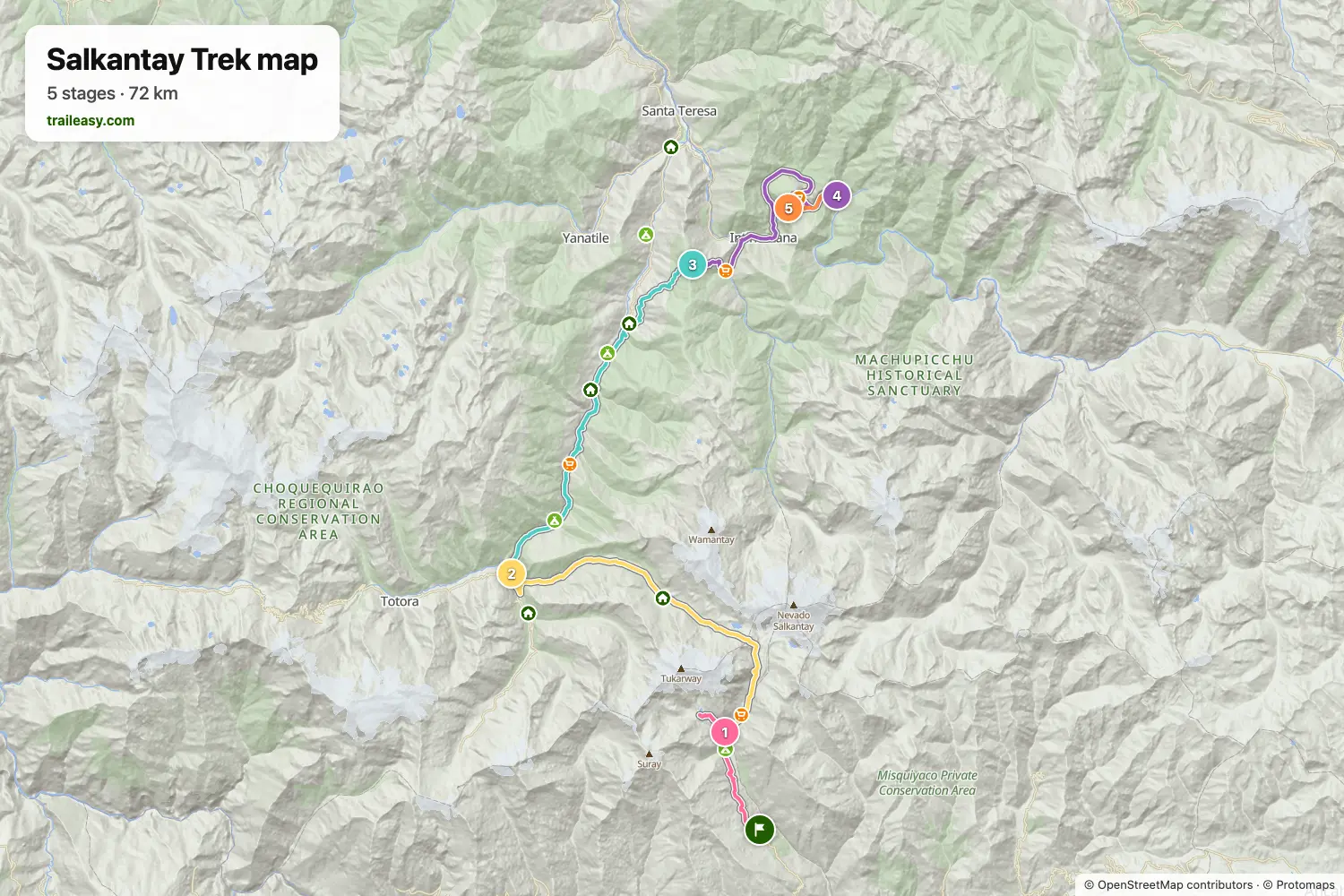
The interactive map shows the whole route, with accommodation, water and public transport along the way.
Salkantay Trek route planner
Build a day-by-day itinerary in the route planner, find accommodations along the route, and download the GPX file. Start from an example below or from scratch.
Classic Salkantay Trek to Machu PicchuShown below
Traditional 5-day Salkantay Trek route passing through high mountain passes, cloud forests, and culminating at Machu Picchu. Experience diverse ecosystems and stunning Andean scenery.
Salkantay Trek stages
5 days, 76 km and 4,874 m of ascent. These stages follow the Classic Salkantay Trek to Machu Picchu itinerary. Open it in the route planner to split or merge days and choose where you sleep.
- Stage 111.1 km↑ 895 m · ↓ 670 m ·
7–8h with stopsTo Soraypampa & Laguna Humantay
Night at Soraypampa Hostel - Cabañas en Laguna Humantay y Salkantay trek - hike on your own - Stage 221.4 km↑ 1,078 m · ↓ 2,147 m ·
11–12h with stopsSoraypampa & Laguna Humantay Collpapampa
Night at CAMPING/HOSTEL EL MOLLE-CAPULICHAYOC - Stage 322.4 km↑ 1,591 m · ↓ 1,611 m ·
9–10h with stopsCollpapampa Llactapata
Night at Mesa Pata Inca Observatory Camping, Hospedaje and Restaurant - Stage 416.4 km↑ 707 m · ↓ 1,458 m ·
6–7h with stopsLlactapata Aguas Calientes
Night at Casa Andina Standard Machu Picchu - Stage 55.0 km↑ 603 m · ↓ 228 m ·
2–3h with stopsAguas Calientes Machu Picchu
Best time to go
- Best time1 Apr – 31 Oct
- Good time1 Nov – 30 Nov
- Possible, with care1 Dec – 31 Mar
April to October is the Andean dry season and the whole of it works, with settled weather and clear views of the peaks. June to August is the driest and busiest stretch and also the coldest, since nights near the pass drop below freezing even when the days are warm. From December to March the rain turns the path to mud, hides the mountains in cloud and raises the risk of landslides on the steeper sections, though unlike the Inca Trail the route never closes.
Frequently asked questions
Can you do the Salkantay Trek without a guide?
Yes, and it is one of the easier long treks in Peru to arrange yourself. No permit is needed for the Salkantay route, unlike the Inca Trail, which requires a booked permit and a licensed guide months ahead. You pay a small local trail fee when you register in Mollepata and buy a Machu Picchu ticket separately, and that is the whole of the paperwork. All three nights can be booked over WhatsApp from Cusco without going through an agency at any point. The path is well trodden and easy to follow, the villages along the way all have places to sleep and eat, and you will pass other hikers every day, so going independently is mostly a matter of booking beds and sorting transport. A guided group still makes sense if you want everything arranged for you or prefer the social side of walking with others, though it costs several times more and fixes your pace to the group's.
How many days does the Salkantay Trek take?
Four walking days from the trailhead to Aguas Calientes, with a fifth day for Machu Picchu itself. Operators sell it as both a four day and a five day trek, but the difference is usually how they count the Machu Picchu day rather than any extra walking. Day two is the long one, crossing the Salkantay Pass at 4600m and then dropping a long way into the cloud forest, and most people find the days after it much gentler. The choice that actually changes your trip is where day three ends: stopping at Lucmabamba is the common option, while pushing on and up to Llactapata means a hot afternoon climb but shortens the final day. A night up at Llactapata, at the Mesa Pata Observatory for example, gets you into Aguas Calientes by late morning with time to sort Machu Picchu tickets, and the view across to the ruins from up there is worth the climb on its own. One thing to know about that day: in July 2025 one party at the bridge after Collpapampa was told the riverside footpath was shut by a landslide, when it had in fact already reopened. Conditions here change faster than the advice about them does. In the Traileasy planner you can move where each day finishes and see straight away what that does to the day after, so you can test both versions of day three before you book anything.
How difficult is the Salkantay Trek, and is it harder than the Inca Trail?
The walking is moderate and a reasonably fit beginner can manage it, but the altitude is what makes it hard. There is no scrambling or exposure anywhere on the route and the path is wide and clear, so no technical hill experience is needed and ordinary fitness is enough for the walking itself. The problem is that the first night at Soraypampa already sits near 3900m, and day two takes you over the Salkantay Pass at 4600m, which is high enough that headaches, breathlessness and broken sleep are common. Three nights in Cusco first is a good way to adjust. In July 2025 the climb to the pass took about two and a half hours and the descent another four and a half. Slower walkers at altitude should allow more and start early. It is harder than the Inca Trail mainly because it goes higher, since the Salkantay Pass sits well above Dead Woman's Pass and this route covers more ground with bigger daily climbs and descents, while what makes the Inca Trail hard is its relentless stone staircases. The trade-off is access: the Inca Trail needs a permit booked months ahead and a licensed guide, caps the number of walkers each day and closes every February, whereas Salkantay needs neither and can be arranged at short notice. After the pass the route drops steadily into warm cloud forest and the remaining days are much easier, so the hardest part is behind you by the second afternoon.
How much does the Salkantay Trek cost without a guide?
A four day unguided walk in July 2025 came to 678 soles per person, including the Machu Picchu ticket. Guided packages start near 300 US dollars and climb well past 700 for the glamping and lodge versions, so arranging it yourself is usually the cheapest way to reach Machu Picchu on foot. The Machu Picchu entry ticket was the single biggest line at 171 soles, followed by about 100 soles of colectivo fares in and out and the 20 soles trail fee at Mollepata. Beds with dinner and breakfast included ran to 40 to 70 soles a night, which is most of what you spend on the trail itself, plus small things like the five soles sandwiches a lodge in Collpapampa sold for the next day. Prices drift year to year and the Machu Picchu ticket in particular has risen repeatedly, so treat these as the shape of the budget rather than exact figures.
Do you need to book accommodation on the Salkantay Trek in advance?
In high season, yes, at least a few days ahead. Every overnight stop on the route has somewhere to sleep, from basic dorm beds and tents to private cabins and the glass domes, but the private rooms and the domes are limited and go first between June and August. Most of these places are small family run lodges that take bookings over WhatsApp rather than through any booking site, and they usually quote a per person price with dinner and breakfast included. In July 2025 three such lodges charged 40 to 70 soles a head, with dinner at six and breakfast early enough to be walking by seven. Bring enough cash from Cusco for the whole trek, because those lodges took cash only and there are no machines until Aguas Calientes. Traileasy shows you which village each night falls in as you build the route, so you know exactly which places to message before you leave Cusco.
How do you get from Cusco to the Salkantay trailhead, and back at the end?
Take an early colectivo from Cusco to Mollepata, then a taxi up to the trailhead near Soraypampa. The colectivos leave when they fill rather than to a timetable, so arriving around 06:30 is sensible; in July 2025 one left a little after seven, cost 20 soles and took a little over two hours. Everyone stops at the tourist office in Mollepata to register and pay the trail fee, which was 20 soles in 2025, and from there a taxi up to the trailhead runs around 30 soles a person if you share it, which is easy to arrange with other hikers off the same colectivo. The way up can close after heavy rain. In February 2026 landslides shut access to the Salkantay and Humantay area for a month, and the Mollepata council reopened it in March on an alternate route that the regional tourism office said was not yet safe. By August 2026 walkers were using it again, though after an earthquake that month the regional government was weighing a temporary closure, so ask at the Mollepata office before you commit, above all in the rainy season. Coming home, walk the train tracks from Aguas Calientes back to Hidroelectrica and pick up a colectivo to Cusco for about 50 soles, which run regularly until late afternoon. The alternative is the train, but tickets have to be bought in Cusco or Aguas Calientes rather than at Hidroelectrica, so decide before you set off. All of this is cash only, so withdraw what you need in Cusco.
How do you get Machu Picchu tickets at the end of the trek?
Buy them online in advance if you are walking in high season. For dates between May and September, the popular morning slots on Circuit 2 can sell out three to four months ahead, and Huayna Picchu goes earlier still, so booking before you fly is the safe option. If you arrive without one, the Ministry of Culture sells a daily quota of 1,000 tickets in person at the Centro Cultural in Aguas Calientes, normally for the next day. The system changed in August 2025: the free numbered pre-ticket was dropped, five windows now open from 06:00, and they take cards. In the busy months of 2026 the Cusco culture office also sold tickets up to three days ahead, as an exceptional measure, when the nearer dates filled. That is the main argument for getting to Aguas Calientes early on your last walking day, since arriving late leaves you taking whatever is left. Ticket rules, circuit numbering and release windows change often in Peru, so check the Ministry of Culture's ticket site, tuboleto.cultura.pe, for your dates rather than relying on a guide written a year earlier.