
Lechweg
About Lechweg
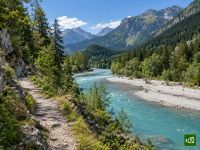
The Lechweg follows the Lech from its source near the Formarinsee, above Lech am Arlberg, down the Tyrolean Lechtal to the Lechfall in Füssen. It runs beside one of Europe's last wild rivers, turquoise and braided across wide gravel banks, through Walser villages and past the painted façades of Holzgau, and near the end it skirts the Alpsee below the royal castles of Neuschwanstein and Hohenschwangau.
Lechweg map
The interactive map shows the whole route, with accommodation, water and public transport along the way.
Lechweg route planner
Build a day-by-day itinerary in the route planner, find accommodations along the route, and download the GPX file. Start from an example below or from scratch.
8-Day ItineraryShown below
The Lechweg in the operator's relaxed eight-stage plan, from the Freiburger Hütte above the Formarinsee, near the source of the Lech, down to the Lechfall in Füssen. The first day drops from the high pastures to Lech, the second climbs above the village to the Grenztobel and on up to the Walser village of Warth, and the third follows the panorama path past Lechleiten and down into the Tyrolean Lechtal to Steeg. From there the walk follows the Lech past the painted houses of Holzgau and the Simms waterfall to Bach, beside the river past Elbigenalp and Häselgehr to Elmen, and along the wide gravel beds of one of the last wild rivers in the Alps through Stanzach to Weißenbach. The seventh day passes Höfen and Wängle to Pflach, just outside Reutte, and the last crosses into Bavaria, skirting the Alpsee below the royal castles and climbing the Kalvarienberg before finishing at the Lechfall.
Lechweg stages
8 days, 130 km and 2,929 m of ascent. These stages follow the 8-Day Itinerary. Open it in the route planner to split or merge days and choose where you sleep.
- Stage 115.9 km↑ 194 m · ↓ 672 m ·
5–6h with stopsTo Lech
Night at Hotel Arlberg Lech - Stage 211.6 km↑ 465 m · ↓ 398 m ·
4–5h with stopsLech Warth
Night at Wellnesshotel Warther Hof - Stage 315.0 km↑ 298 m · ↓ 689 m ·
5–6h with stopsWarth Steeg
Night at Lechquell Hotel Post - Stage 415.6 km↑ 531 m · ↓ 591 m ·
5–6h with stopsSteeg Bach
Night at Hotel Post - Stage 516.5 km↑ 205 m · ↓ 291 m ·
5–6h with stopsBach Elmen
Night at Gasthof Kaiserkrone - Stage 621.0 km↑ 332 m · ↓ 419 m ·
6–7h with stopsElmen Weißenbach am Lech
Night at Hotel-Gasthof Goldenes Lamm - Stage 718.8 km↑ 395 m · ↓ 440 m ·
6–7h with stopsWeißenbach am Lech Pflach
Night at Gasthof Alpenblick - Stage 815.7 km↑ 509 m · ↓ 545 m ·
5–6h with stopsPflach Füssen
Best time to go
- Best time1 Jul – 30 Sept
- Good time16 Jun – 30 Jun
- Possible, with care16 May – 15 Jun, 1 Oct – 15 Oct
The full route opens in the second half of June, once the last snow has gone from the high section between the Formarinsee and Warth, and stays open until the middle of October. July to September is the best time, with Lech in its summer season and the hiking bus running up to the Formarinsee from morning to evening. From the middle of May a shortened route starts lower down, at Steeg or Warth. From early October fewer beds are open in Lech and the Formarinsee bus runs only a few times a day.
Frequently asked questions
When is the best time to walk the Lechweg, and can you start before the Formarinsee section opens?
July to September is the surest time, and the full route is walkable from the second half of June. Until then old snow lies on the first two sections, from the Formarinsee to Warth, and beds in Lech and Warth open only with the summer season, when the hiking bus up to the Formarinsee starts too. The date moves with the snowmelt. In 2026 the operator opened the full length on 18 June. From the middle of May you can already walk the operator's shortened spring version, which starts lower down in Steeg, or in Warth after a good snowmelt. The operator gives the middle of October as the end of the season for the whole route, but from early October Lech's summer season is over, fewer beds are open there and the Formarinsee bus runs a reduced timetable, so it recommends starting at Steeg then as well. Opening dates and bus seasons change from year to year, so check the operator's current notices before you book.
How long does the Lechweg take, and how are the stages divided?
Seven or eight days for most walkers. The operator splits the Lechweg into 15 sections and suggests three plans: seven days for fit walkers, where the challenge is the length of each day, eight days for anyone who likes walking, and ten days with two rest days built in. The classic seven-day plan stops overnight in Lech, Lechleiten, Holzgau, Elbigenalp, Stanzach and Wängle before the finish in Füssen. The eight-day plan breaks the route at Lech, Warth, Steeg, Bach, Elmen, Weißenbach and Pflach instead. The last classic day into Füssen is the longest and has the most climbing, at around ten hours on foot over the Kniepass to the Alpsee. Wikipedia gives six to eight stages. Because every section ends in a village, you can also set your own split.
How difficult is the Lechweg?
Moderate, with long days rather than hard terrain. The operator describes it as moderate long-distance walking and stresses that this still means more than a stroll, because you walk several stages in a row. According to the operator there is no climbing and no fixed-rope section, and no alpine experience is needed. Most of the way the path follows the river downstream from the Formarinsee. Of the 15 sections, the operator grades two as demanding walking paths, Holzgau to Bach and Wängle to Pflach, and five as easy mountain paths: the three from the Formarinsee to Steeg, Elmen to Vorderhornbach, and the last one over the Kniepass to Füssen. The rest are easy paths along the valley floor. Walked the other way, from Füssen to the source, it is a little harder, with noticeably more climbing. Don't start a stage when thunderstorms are forecast, the operator advises.
Do you have to cross the Holzgau suspension bridge on the Lechweg?
No. The Lechweg's operator calls the path up the Höhenbachtal past the Simms waterfall the original route, and offers the suspension bridge as the alternative for walkers with a head for heights. Both leave Holzgau and meet again on the far side of the gorge, so you can decide on the day. The bridge spans the Höhenbach gorge high above the stream, and its walkway is laid with open metal grating. The valley route is the longer of the two and the one that passes the waterfall. Holzgau's municipality lists the bridge as open around the clock, though it is worth checking locally before you rely on it. The other suspension bridge on the way, at Forchach, is not on the route at all, although the operator says it is well worth walking onto. In the Traileasy planner the bridge crossing is its own variant, Hängebrücke Holzgau, so you can swap it in for the valley loop and see what it changes about that day.
How do you get to the start at the Formarinsee, and back from Füssen?
By the hiking bus from Lech. Line 707 runs from Lech up the Zugertal to the Formarinsee stop, where the Lechweg begins, between mid-June and early October. Tickets are sold at the tourist office in the Dorfhus or on the bus, and the fare includes the road toll. In 2026 the summer timetable ran from 18 June to 4 October, with fewer buses until late October. To reach Lech itself, the operator points to the railway stations at Langen am Arlberg and St. Anton am Arlberg, with buses on to Lech. Füssen, at the finish, has its own station. If you left a car in Lech, take bus 100 from Füssen to Reutte station and bus 110 from there up the Lechtal; the operator puts the whole ride at just under three hours and warns that the last connection through to Lech leaves Füssen in the early afternoon. Timetables change several times a season, so check the current times with the Tyrolean transport association VVT before you travel.
Where do you stay on the Lechweg, and can you walk it without carrying your luggage?
In guesthouses and hotels in the villages, and yes, your luggage can be carried for you. The Lechweg runs from village to village. The operator lists partner hosts in Lech, Warth, the Lechtal, the Reutte area and Füssen, and advises booking ahead, since July and August are high season in every village on the route. Beds in Lech and Warth open only with the summer season. For luggage, the Lechweg shuttle run by the company Feuerstein takes your bags to the next accommodation each day; book it directly with them up to two days before, or ask your host to arrange it at short notice. Several tour operators also sell the whole route as a package without luggage. Another option is the operator's 'Lechweg komfortabel' idea: book two or three bases, one each for the upper, middle and lower sections, and ride the buses to and from each day's walk. The Traileasy planner puts a nightly stop at the end of every day as you split the route, which shows quickly when a stage ends somewhere like Elmen, whose centre lies off the trail.
Where can you swim along the Lechweg?
In several lakes and one forest pool. On the first section the forest pool between Lech and Zug is open in good weather during the summer season, and entry is included with the Lech Card guest card. Between Forchach and Weißenbach the path passes a former gravel-pit lake with barbecue spots, which the Naturparkregion Reutte lists as a bathing spot, though only part of it is deep enough to swim. The Frauensee, on the stretch from Wängle to Pflach, is a natural bathing lake with a raft, a diving board and the Frauenseestube beside it. On the last day the path follows the Alpsee below the royal castles; its bathing area, the Alpseebad, is on the south shore a short detour from the trail, and the Schwansee further on has a bathing spot by its kiosk. For the river itself, local guides take groups wild-water swimming through the Lech gorge between Lech and Warth. Opening times and conditions change with the season, so check locally.
Can you walk the Lechweg with a dog?
Yes. The operator says the Lechweg can be walked with a dog, and it marks dog-friendly hosts with a pictogram, both in its service booklet and in the facilities filter of its online host list. On the buses along the route dogs must wear a muzzle and be kept on a lead, which matters for the hiking bus to the Formarinsee and for any bus you take between stages. The walkway of the Holzgau suspension bridge is metal grating, but the original route through the Höhenbachtal does not cross the bridge.