
Kerry Way
About Kerry Way
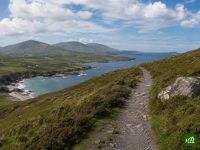
The Kerry Way circles the Iveragh Peninsula from Killarney, on old butter roads and green lanes beneath the MacGillycuddy's Reeks. It leaves the oakwoods of Killarney National Park for the Black Valley, runs high above Dingle Bay and the Skelligs, then works back east along the Kenmare River to close the loop.
Kerry Way map
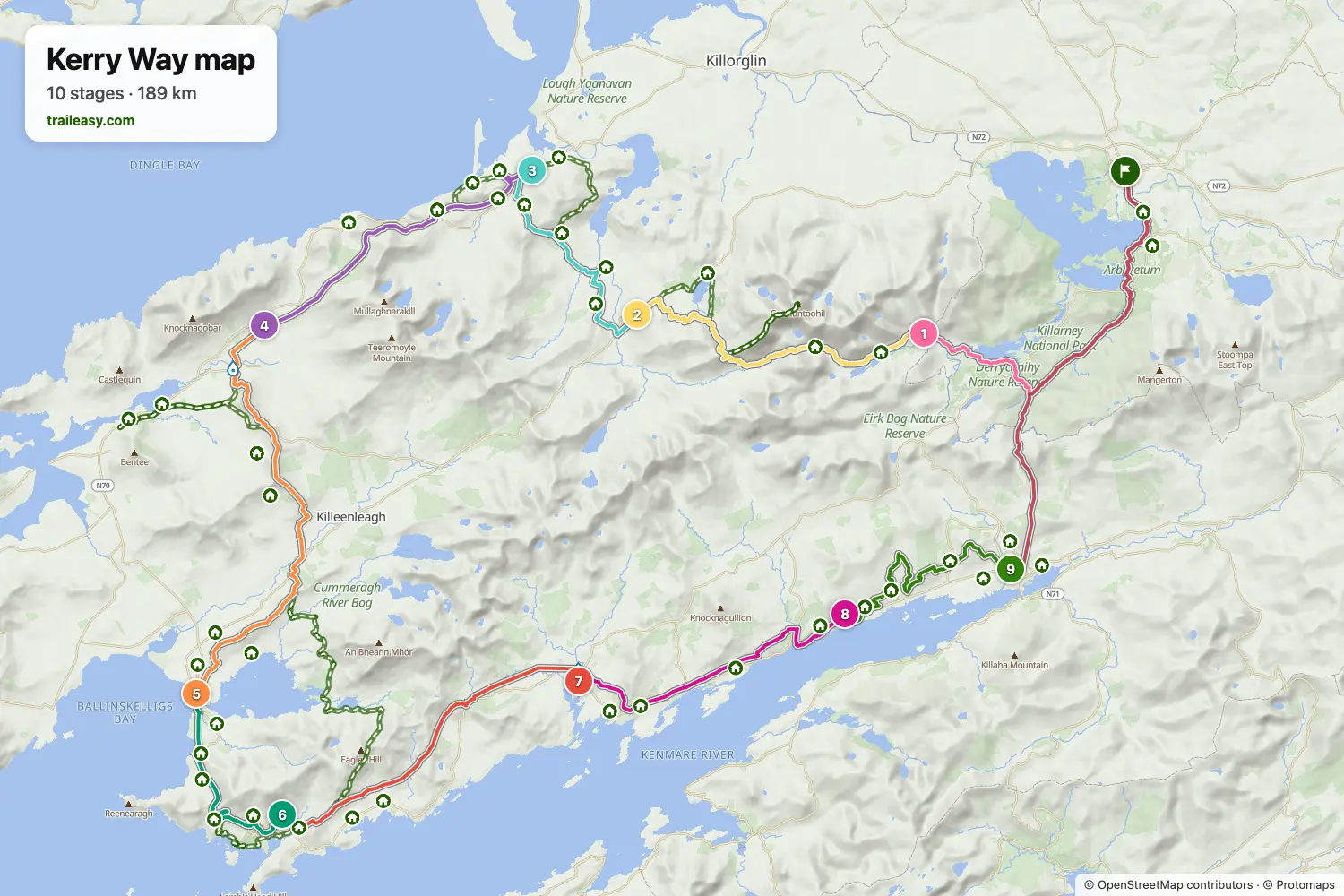
The interactive map shows the whole route, with accommodation, water and public transport along the way.
Kerry Way route planner
Build a day-by-day itinerary in the route planner, find accommodations along the route, and download the GPX file. Start from an example below or from scratch.
10-Day ItineraryShown below
A full circuit of the Iveragh Peninsula from Killarney, following the main line rather than the Cahersiveen spur. It climbs out of the National Park oakwoods into the Black Valley beneath the MacGillycuddy's Reeks, works west through Glencar and Glenbeigh on old butter roads high above Dingle Bay, then rounds the peninsula at Waterville and Caherdaniel before turning east along the Kenmare River through Sneem and Kenmare to close the loop.
Kerry Way stages
10 days, 194 km and 5,293 m of ascent. These stages follow the 10-Day Itinerary. Open it in the route planner to split or merge days and choose where you sleep.
- Stage 123.1 km↑ 508 m · ↓ 459 m ·
7–8h with stopsKillarney the Black Valley
Night at Black Valley Hostel - Stage 219.8 km↑ 620 m · ↓ 619 m ·
6–7h with stopsthe Black Valley Glencar
Night at The Climbers Inn - Stage 314.1 km↑ 406 m · ↓ 455 m ·
4–5h with stopsGlencar Glenbeigh
Night at The Glenbeigh Hotel - Stage 417.9 km↑ 497 m · ↓ 459 m ·
6–7h with stopsGlenbeigh Foilmore
Night at Limateerha House B&B - Stage 525.8 km↑ 880 m · ↓ 940 m ·
9–10h with stopsFoilmore Waterville
Night at Butler Arms Hotel - Stage 612.9 km↑ 365 m · ↓ 308 m ·
4–5h with stopsWaterville Caherdaniel
Night at Derrynane Bay House - Stage 719.3 km↑ 467 m · ↓ 528 m ·
6–7h with stopsCaherdaniel Sneem
Night at Sneem Hotel - Stage 818.3 km↑ 468 m · ↓ 413 m ·
6–7h with stopsSneem Tahilla
Night at Greenwood Hostel - Stage 917.3 km↑ 400 m · ↓ 447 m ·
5–6h with stopsTahilla Kenmare
Night at Kenmare Bay Hotel & Resort - Stage 1025.7 km↑ 682 m · ↓ 666 m ·
8–9h with stopsKenmare Killarney
Best time to go
- Best time1 May – 30 Jun, 1 Sept – 30 Sept
- Good time1 Apr – 30 Apr, 1 Jul – 31 Aug, 1 Oct – 31 Oct
- Possible, with care1 Nov – 31 Mar
May, June and September are the best months, with the best balance of daylight, weather and quiet trails. July and August are warmest and busiest, so beds in the smaller villages book up and the stages near Killarney get crowded. From November to March the boggy sections hold water from the winter and some accommodation on the quieter western stretches closes for the season.
Frequently asked questions
How long does it take to walk the Kerry Way?
Most walkers take between eight and ten days for the full circuit from Killarney back to Killarney. The guidebook splits it into ten stages, each a comfortable day, and the shortest sensible plan is around a week if you are happy with longer days and fewer stops. Published lengths vary a lot because sources count different things: the figure you usually see includes the waymarked alternatives and the link into Cahersiveen, while the circuit on its own is shorter. Your own total depends on which options you take, since detouring into Cahersiveen adds most of a day and climbing Carrauntoohil adds a full one. Allow a spare day if you want either of those, or if the weather forces a short one.
What is the best time of year to walk the Kerry Way?
May, June and September. It is worth being honest about what you are choosing for, because this is one of the wettest corners of Ireland and no month reliably avoids rain. What the season actually buys you is daylight and open doors, not dry weather. The other thing that lags behind the calendar is the ground: the boggy stretches hold winter water long after spring has arrived, so an early May walk can be wetter underfoot than a September one on the same forecast. Late summer is the driest the ground gets all year, which is part of why the popular stages near Killarney feel busy then.
How difficult is the Kerry Way?
Moderate, and the difficulty is underfoot rather than uphill. There is no scrambling and no exposure on the main route, but long stretches cross open bog and rough pasture that stay wet even in summer, so waterproof boots and gaiters matter more here than fitness does. The climbs are steady rather than steep, with the sustained ones between the Black Valley and Glencar and again on the crossing to Caherdaniel. The remote sections have no shelter and patchy phone signal, so a day that starts badly stays that way until the next village. Anyone comfortable with consecutive days of hill walking in poor weather will manage it, though it is not a good first multi-day trail for someone who has only walked dry, made-up paths.
Do you need to book accommodation on the Kerry Way in advance?
Yes, and earlier than the trail's reputation suggests. The villages along the route are small, several have only a handful of beds, and walkers compete with Ring of Kerry tourists for the same rooms through the summer. For July and August, book as soon as your dates are fixed and ideally several months out; in shoulder season a few weeks is usually enough, though the quieter western villages have fewer options and some close entirely. Plan the whole chain before booking any of it, because one full village forces a much longer day rather than a slightly different one. Traileasy shows which village each night falls in as you move the stages around, so the tight spots are visible before you commit to any of the bookings.
Can you wild camp on the Kerry Way?
Not freely, and the rules in Ireland are stricter than many walkers expect. There is no general right to wild camp: almost all the land along the route is privately owned or farmed, so camping legally means asking the landowner first. Camping is banned outright in Killarney National Park, which covers the opening and closing stages, and rangers do move people on. Campsites do exist at Killarney, Glenbeigh, Waterville and Caherdaniel, so a tent-based trip works if you plan the stages around them rather than around wherever you happen to stop. Anyone arriving from Scotland or Scandinavia should build this trail around beds or campsites, since the freedom to camp where you like does not apply here.