
Kepler Track
About Kepler Track
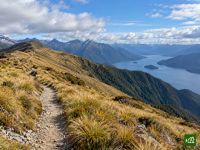
A loop from the shore of Lake Te Anau into the mountains of Fiordland National Park, and one of New Zealand's Great Walks. It climbs through beech forest onto open tops above the bushline and follows an exposed ridge with views over Lake Te Anau and Lake Manapouri, then drops into the Iris Burn valley and returns through lowland forest beside Lake Manapouri and the Waiau River.
Kepler Track map
The interactive map shows the whole route, with accommodation, water and public transport along the way.
Kepler Track route planner
Build a day-by-day itinerary in the route planner, find accommodations along the route, and download the GPX file. Start from an example below or from scratch.
4-Day ItineraryShown below
The Kepler Track in the four days and three nights most walkers take, in the direction the Department of Conservation describes it and with each night in one of the three Great Walk huts. The first day sets off from the control gates where the Waiau River leaves Lake Te Anau, follows the lakeshore to Brod Bay and climbs through beech forest above the bushline to Luxmore Hut. The second is the alpine day, along an exposed ridge with views over Lake Te Anau and Lake Manapouri, before a long descent into the Iris Burn valley. The third follows the Iris Burn down through the forest to Moturau Hut on the shore of Lake Manapouri, and the last passes Rainbow Reach and follows the Waiau River back to the control gates and on into Te Anau.
Kepler Track stages
4 days, 63 km and 2,071 m of ascent. These stages follow the 4-Day Itinerary. Open it in the route planner to split or merge days and choose where you sleep.
- Stage 114.3 km↑ 911 m · ↓ 86 m ·
5–6h with stopsTe Anau Luxmore Hut
Night at Luxmore Hut - Stage 214.1 km↑ 693 m · ↓ 1,270 m ·
5–6h with stopsLuxmore Hut Iris Burn Hut
Night at Iris Burn Hut - Stage 315.7 km↑ 224 m · ↓ 505 m ·
5–6h with stopsIris Burn Hut Moturau Hut
Night at Moturau Hut - Stage 418.8 km↑ 243 m · ↓ 220 m ·
5–6h with stopsMoturau Hut Te Anau
Best time to go
- Best time1 Dec – 30 Apr
- Good time27 Oct – 30 Nov
The Great Walks season runs from 27 October to 30 April, when every hut and campsite must be booked. December to April is the best time, with the huts close to full all summer. In late October and November DOC may still close the alpine section between Luxmore and Iris Burn huts for avalanche risk, occasionally into December. From May to late October the snowy tops are avalanche terrain that DOC no longer manages, and crossing them takes winter alpine skills and kit.
Frequently asked questions
Can you walk the Kepler Track in winter, outside the Great Walks season?
Yes, but from May to late October it is a winter alpine trip rather than a Great Walk. DOC grades it an advanced or expert track for those months and does not manage hazards such as avalanches and flooding. It counts nine avalanche paths on the Kepler, and most of them can cross the track, while the route over the tops is unmarked and often under thick snow. DOC's winter kit list adds an ice axe, crampons, an avalanche beacon, a shovel, a probe and a personal locator beacon. At the huts there are no rangers, no gas and no emergency radio. Only Luxmore Hut needs a booking. Iris Burn, Moturau and the campsites are first come, first served, at much lower fees. Shuttles run only with minimum numbers, so arrange transport before you start, and DOC asks you to check the New Zealand Avalanche Advisory for Fiordland and talk to the Fiordland National Park Visitor Centre in Te Anau first. DOC sets these dates and rules each season, so confirm them before you go.
How long does it take to walk the Kepler Track, and can you do it in two days or one?
Most walkers take four days and three nights, sleeping at Luxmore, Iris Burn and Moturau huts in turn. DOC gives three to four days. On three, you sleep at Luxmore and Iris Burn, skip Moturau and walk out from Iris Burn to the Rainbow Reach shuttle on the last day, which DOC's times put at six and a half to eight hours. Two days is only for fit, fast walkers. Whichever hut takes the single night, one of the two days has to add the climb from the lake or the long valley walk to the whole alpine section, and that day runs to ten hours or more on DOC's figures. The one-day version is the Kepler Challenge, a mountain run held over the track on the first Saturday of December, when DOC warns the track is busy with runners. On foot, DOC's day walk from the car park up to Luxmore Hut gets you onto the tops and back. Sketch the loop as three nights and then as four in the Traileasy planner, and you can see how long each day comes out, which is worth settling before booking day.
Is the Kepler Track hard, and is it harder than the Routeburn?
It is a moderate tramp in summer, and the hard walking comes on the climb to Luxmore and the day across the tops. In the Great Walks season DOC grades it an intermediate tramping track. The track is well marked, but some sections are steep, rough, muddy and slippery. Walked anticlockwise, day one climbs from Brod Bay under limestone bluffs to the bushline and on to Luxmore Hut. Day two spends five to six hours on the open tops before dropping over the Forest Burn Saddle into the Iris Burn valley, with no reliable water between the two huts, so fill your bottles at Luxmore. From there it gets much easier. The Routeburn carries the same intermediate grade in season, and day for day the two are alike, each with one long alpine stage. The Kepler is nearly twice as long and opens with a hard climb, so as a whole trip it asks more of you. DOC does not recommend it for children under ten because of the exposed mountain terrain and the often poor weather.
Where does the Kepler Track start, and which way round should you walk it?
Most walkers start at the Kepler Track car park by the control gates, a short drive from Te Anau. The loop can be walked either way, and DOC describes it anticlockwise, from the car park to Brod Bay and up to Luxmore Hut. That order gets most of the climbing done on the first day, and a night at Luxmore lets you look at the weather before committing to the open tops. Clockwise works just as well. Often the choice comes down to which hut nights you manage to book. You can also walk to the start from the Fiordland National Park Visitor Centre, about fifty minutes along the lakefront, or take the short water taxi from the Te Anau lakefront across to Brod Bay. The other road access is Rainbow Reach, where a swing bridge crosses the Waiau River and you can leave the track for a shuttle instead of walking the last riverside stretch back to the car park. In the Great Walks season shuttles run daily to both points and collect from accommodation in Te Anau. Book seats ahead and check the timetable for your dates.
How do you book the Kepler Track huts and campsites, and how fast do they fill?
Book through DOC's online booking system, and for a summer trip be ready on the morning bookings open. Every hut and campsite has to be booked for the Great Walks season, and without a booking you can be charged a penalty, or turned away if the hut is full. For the 2026/27 season Kepler bookings opened at 9:30 am on 19 May 2026. On opening mornings DOC runs a virtual queue: everyone already waiting in the lobby when bookings open gets a random place, so arriving early gains nothing, but logging in after the opening puts you at the back. Demand is high. Last summer the Kepler huts ran at 91 per cent occupancy, close behind the Milford and the Abel Tasman. The three huts are Luxmore, Iris Burn and Moturau, and the two campsites are at Brod Bay and Iris Burn. For 2026/27 a hut costs NZ$88 per person per night for New Zealanders and NZ$132 for international visitors, and a campsite NZ$28 or NZ$42 on the same basis. Opening dates and fees are reset every year, so check DOC's Kepler Track page before booking day.
Can you camp on the Kepler Track?
Yes, but only at the two DOC campsites, Brod Bay and Iris Burn, and both have to be booked in the Great Walks season. There is no campsite at Luxmore or Moturau, and camping or staying overnight in the Forest Burn and Hanging Valley shelters is not allowed. That decides how a camping trip runs. From Brod Bay the next place you can pitch a tent is Iris Burn, so day two takes in the climb to Luxmore and then the whole alpine section, eight and a half to ten and a half hours on DOC's times. Each campsite has fifteen tent sites, toilets and a tap whose water DOC says to boil. Campers cannot use the hut facilities, so bring a gas cooker. Kea around Iris Burn and on the alpine section take a close interest in tents and camping gear, so guard yours. If the huts are full for your dates, look at the campsites before giving up, since DOC reported that many campsites still had space last summer while Great Walk huts were full.