
Huayhuash Circuit
About Huayhuash Circuit
A remote high circuit around the Cordillera Huayhuash, a compact chain of glaciated peaks in the Peruvian Andes. It crosses one thin pass after another between turquoise lakes and hanging glaciers, beneath Yerupajá, Siula Grande and Jirishanca, camping every night far from the nearest road.
Huayhuash Circuit map
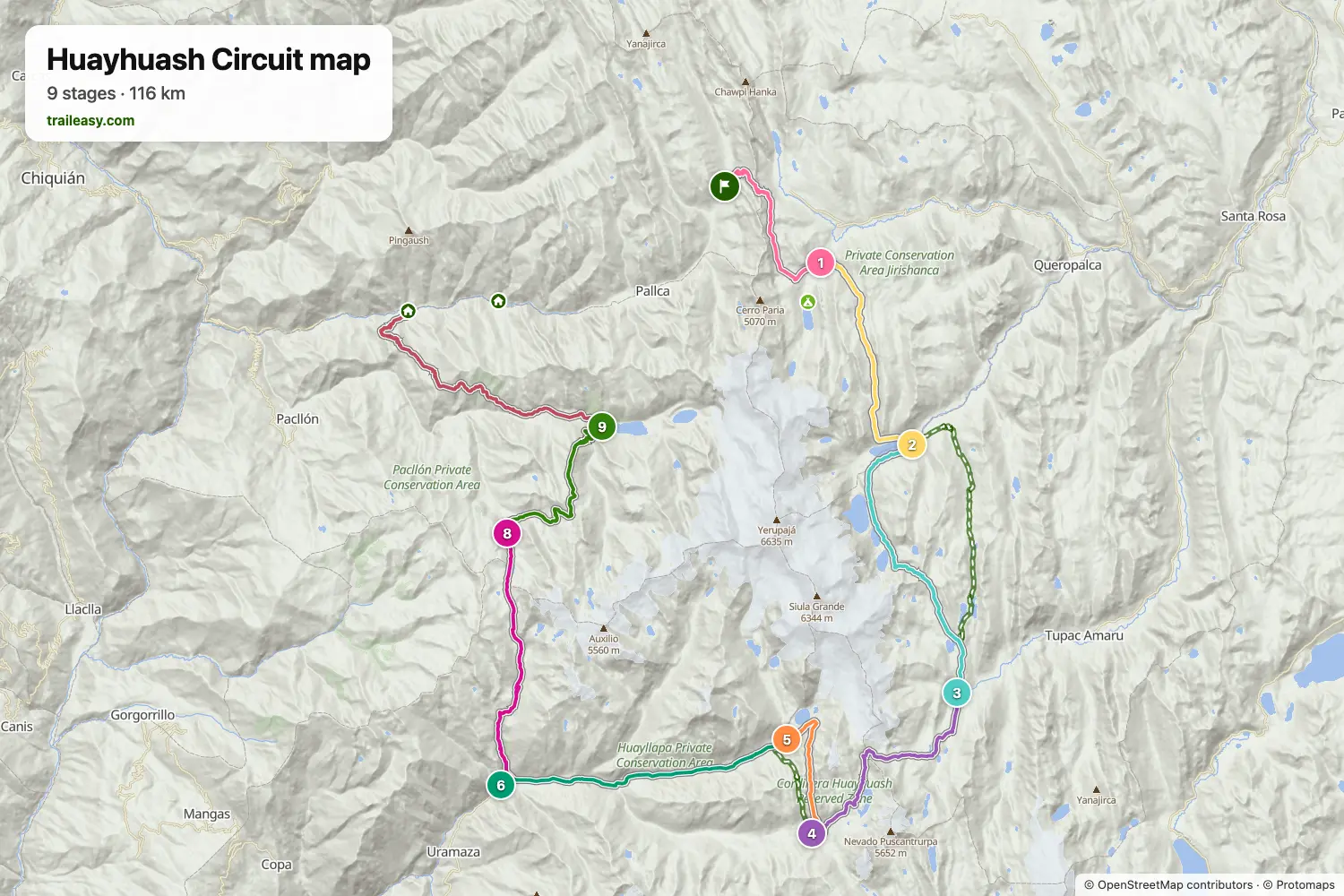
The interactive map shows the whole route, with accommodation, water and public transport along the way.
Huayhuash Circuit route planner
Build a day-by-day itinerary in the route planner, find accommodations along the route, and download the GPX file. Start from an example below or from scratch.
10-Day ItineraryShown below
A loop of the Cordillera Huayhuash, from the roadhead at Cuartelhuain back out to Llamac, camping every night. This split takes the high alpine line the mule trains cannot follow: over Cacanapunta to Janca, past the Tres Lagunas viewpoint above Laguna Carhuacocha, then across Paso Trapecio and Paso Santa Rosa, the highest crossing of the circuit, dropping to Cutatambo beneath Siula Grande. After a rest day in Huayllapa it climbs back over the western passes and finishes on the high route above Laguna Jahuacocha, with Yerupaja filling the skyline.
Huayhuash Circuit stages
10 days, 95 km and 5,443 m of ascent. These stages follow the 10-Day Itinerary. Open it in the route planner to split or merge days and choose where you sleep.
- Stage 18.5 km↑ 678 m · ↓ 603 m ·
5–6h with stopsCuartelhuain Janca
Straight into the altitude with a climb to the first pass, short but hard this high up.
Night at Campamento Janca - Stage 29.6 km↑ 389 m · ↓ 472 m ·
4–5h with stopsJanca Laguna Carhuacocha
Another pass and a descent to the finest camp of the circuit, on a lake below the big ice faces.
Night at Campamento Carhuacocha - Stage 313.0 km↑ 763 m · ↓ 576 m ·
6–7h with stopsLaguna Carhuacocha Campamento Huayhuash
The famous one, a high traverse past three lakes with the whole range of ice standing over them.
Night at Campamento Huayhuash - Stage 410.7 km↑ 752 m · ↓ 592 m ·
6–7h with stopsCampamento Huayhuash Campamento Elefante
Over the highest pass of the route, steep and loose on the far side.
Night at Campamento Elefante - Stage 56.1 km↑ 556 m · ↓ 798 m ·
4–5h with stopsCampamento Elefante Cutatambo
Short but hard, over another high pass and down to a camp under the big south faces.
Night at Campamento Cutatambo - Stage 612.0 km↑ 45 m · ↓ 806 m ·
4–5h with stopsCutatambo Huayllapa
All downhill, out of the high country and into the first village in a week.
Night at Hospedaje Huayllapa - Stage 70.0 km↑ 0 m · ↓ 0 m
Huayllapa Huayllapa
A day off in the only village on the circuit, with shops, hot food and a chance to dry everything out.
Night at Hospedaje Huayllapa - Stage 812.2 km↑ 1,320 m · ↓ 292 m ·
8–9h with stopsHuayllapa Gashpapampa
The steepest climb of the route, straight up out of the village and back onto the high ground.
Night at Campamento Gashpapampa - Stage 99.6 km↑ 522 m · ↓ 985 m ·
5–6h with stopsGashpapampa Laguna Jahuacocha
Over a last high pass, then down to a lake camp facing the north side of the range.
Night at Campamento Jahuacocha - Stage 1013.6 km↑ 418 m · ↓ 1,253 m ·
6–7h with stopsLaguna Jahuacocha Llamac
A long descent out of the mountains, over one small pass and down to the road.
Best time to go
- Best time1 May – 30 Sept
- Good time1 Apr – 30 Apr, 1 Oct – 31 Oct
- Possible, with care1 Nov – 30 Nov
May to September is the dry season and the whole of it works, with settled days and nights below freezing at the high camps. April and October sit either side of it with less reliable weather, and November brings the first of the rain. From December to March snow covers the passes, the camps are exposed and there is no shelter on the circuit to retreat to.
Frequently asked questions
When is the best time to hike the Huayhuash Circuit?
The dry season, roughly May to September, and June through August is the most reliable stretch. Those months bring the clearest passes, the driest campsites and the best odds of seeing Yerupajá and Siula Grande rather than cloud. May and September are quieter shoulder months that trade a little stability for far fewer people on the trail. Avoid the wet season from about November to March, when snow on the high passes and poor visibility make the route both harder and less rewarding. Whatever month you pick, every camp sits high enough that nights drop below freezing, so a proper sleeping bag matters year round.
How many days do you need for the Huayhuash Circuit?
Eight days is the standard, and eight to ten is what most independent hikers take. Guided groups run the classic loop in eight because mules carry the weight and the schedule is fixed. Going self-supported, ten days gives room for a rest day in Huayllapa and for the higher alpine passes that mule trains cannot cross. Shorter mini-Huayhuash loops of four or five days cover the scenic eastern section around Laguna Carhuacocha and skip the remote southern passes. At the other end, adding side trips and rest days can stretch a trip to a fortnight. A full day by day breakdown of a ten day independent route sets out where each of those days ends.
How difficult is the Huayhuash Circuit?
Hard, and almost entirely because of the altitude rather than the terrain. The route stays high throughout, most days cross a pass, and the highest of them, Santa Rosa, sits near 5,080 m. Nothing on the standard circuit is technical or exposed enough to need equipment, though two of the descents are steep and loose. Carrying your own tent, food and fuel is what turns a manageable trek into a genuinely tough one, since pack weight and thin air compound each other. Fitness helps, but acclimatization decides it: spend two or three days around Huaraz first and ideally add a warm up such as the Santa Cruz trek or Laguna 69, because a fair share of people who start unacclimatized turn back within three days.
Can you hike the Huayhuash Circuit without a guide?
Yes. No law requires a guide, and independent self-supported trekking is allowed and increasingly common here. What you take on instead is everything a guided group outsources: carrying a tent, ten days of food and fuel, navigating alone, and paying each community fee in cash as you reach it. The main trail is established and easy enough to follow in clear weather, though the higher alpine variants are far less obvious and there is no phone signal across most of the range. Traileasy shows the main line and the alpine variants together, so you can choose which passes to take while planning and keep that route offline on your phone.
How much does the Huayhuash Circuit cost?
Going independently costs roughly a quarter of a guided trip. A recent ten day self-supported trip came to about 900 soles per person, covering transport from Huaraz and back, every community fee, ten days of groceries and two nights in a hostel in Huayllapa, with the community fees alone making up around 270 of that. Guided group tours of the eight day circuit typically run between 560 and 990 US dollars per person, with private trips higher. The gap is almost all labour: a guide, a cook, an arriero and the mules that carry the gear. Bring more cash than you expect to need, in small soles notes, because there is no ATM anywhere on the circuit. A detailed breakdown of what that ten day trek cost itemises every line of it.
What permits and community fees do you need for the Huayhuash Circuit?
There is no single permit. Each community whose land the route crosses sells its own entrance ticket, and you buy them one at a time as you go. Individual tickets run from about 10 to 50 soles, most commonly 20 to 30, and across a full circuit they come to roughly 270 soles per person. The tickets include camping, which is why the sites have flat ground, water nearby and basic toilets. You pay at the campsites, where staff also check the tickets for sections already walked. Fees are set locally and change, so treat those figures as a guide and carry a margin.
What is camping like on the Huayhuash Circuit?
Every night is a tent at a designated community campsite, since there are no huts or lodges anywhere on the route. The sites are flat, sit beside a river or lake, and have basic but clean toilets, and the section fee you pay covers pitching there. Huayllapa, roughly halfway, is the one place with a bed available and a small shop for a light resupply. Nights freeze at every camp, so a sleeping bag rated near or below freezing and an insulated mat are not optional. Because each night lands at a named camp rather than a booked hut, mapping the stages on Traileasy shows which camp each day ends at, which makes it easier to work out the fee owed at each one and carry the right cash.