
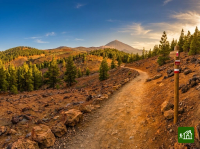
GR131 Tenerife
About GR131 Tenerife
A crossing of Tenerife over the roof of the island, following the Cumbre Dorsal ridge into the crater of Las Cañadas del Teide. It traverses the lunar floor of the caldera beneath Spain's highest peak, then descends through Vilaflor and the pine forests above Ifonche to Arona.
GR131 Tenerife map
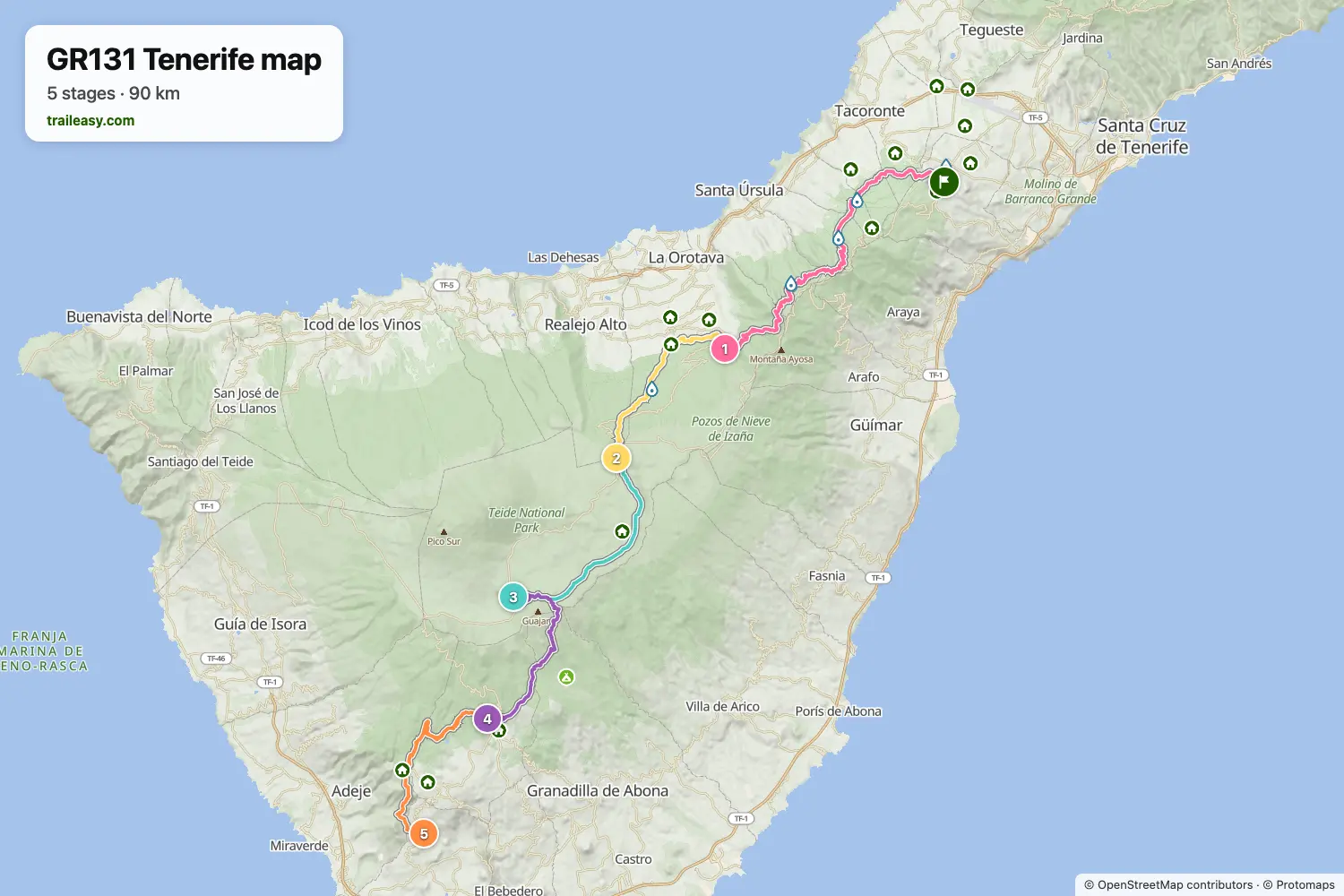
The interactive map shows the whole route, with accommodation, water and public transport along the way.
GR131 Tenerife route planner
Build a day-by-day itinerary in the route planner, find accommodations along the route, and download the GPX file. Start from an example below or from scratch.
5-Day ItineraryShown below
A five day traverse of Tenerife from La Esperanza to Arona, following the Cumbre Dorsal ridge above the cloud into the caldera of Las Cañadas del Teide. The walk crosses the pine forest of the Corona Forestal, spends a night at the Parador beneath Spain's highest peak, then descends through Vilaflor and the ravines above Ifonche to the southern hills.
GR131 Tenerife stages
5 days, 93 km and 3,990 m of ascent. These stages follow the 5-Day Itinerary. Open it in the route planner to split or merge days and choose where you sleep.
- Stage 129.5 km↑ 1,553 m · ↓ 1,292 m ·
11–12h with stopsTo La Caldera
Night at Área de Acampada La Caldera - Stage 215.2 km↑ 1,212 m · ↓ 309 m ·
6–7h with stopsLa Caldera El Portillo
Night at La Casa del Teide, d-espacios - Stage 315.8 km↑ 279 m · ↓ 247 m ·
5–6h with stopsFrom El Portillo
Night at Parador de Las Cañadas del Teide - Stage 416.1 km↑ 531 m · ↓ 1,185 m ·
6–7h with stopsTo Vilaflor
Night at Hotel Spa Villalba - Stage 516.7 km↑ 415 m · ↓ 1,288 m ·
6–7h with stopsVilaflor Arona
Best time to go
- Best time1 May – 30 Jun, 1 Sept – 31 Oct
- Good time1 Apr – 30 Apr, 1 Jul – 31 Aug, 1 Nov – 30 Nov
- Possible, with care1 Dec – 31 Mar
May, June, September and October give the best combination of open trails, settled weather and manageable temperatures at both ends of the route. From December to March the high sections regularly get snow and ice and the park roads close when it settles, which can strand an itinerary halfway. Summer is comfortable up high but punishing on the descent to Vilaflor and Arona, and fire restrictions can close forest paths in dry spells.
Frequently asked questions
Does the GR131 Tenerife go to the summit of Mount Teide?
No. The GR131 crosses the floor of the Las Cañadas caldera beneath Teide rather than climbing it, so you walk past Spain's highest mountain rather than up it. The summit is a side trip from the route, usually made from Montaña Blanca, and both the Montaña Blanca path and the final path above the upper cable car station need a timed booking on Tenerife ON, the Cabildo de Tenerife's reservation site. Since January 2026 most visitors pay for daytime slots: in October 2026 the summit path cost 15 euros for people from outside the Canary Islands and 6 euros for residents of the other islands, and Montaña Blanca cost 6 euros on weekdays and 10 at weekends for visitors from outside the islands. Tenerife residents go free, and so do children under 14 on the summit path. Those slots are limited and go weeks ahead in busy periods, so if the summit matters to you, book it before you fix the rest of your itinerary. Adding it costs a full day and a lot of climbing on top of an already demanding crossing. The Altavista refuge, which makes an overnight ascent easier, reopened on 20 July 2026 after a long renovation. It allows one night per person, costs 71 euros a night for visitors from outside Tenerife, and its booking includes a dawn slot on the summit path the next morning. Check current fees and rules on Tenerife ON before you go.
Do you need a permit to walk the GR131 through Teide National Park?
No, the GR131 itself is open and needs no permit where it crosses the park. Permits come into it for two separate things: climbing the final cone of Teide, which needs a free timed reservation, and sleeping anywhere inside the park, which is tightly controlled. The other park rules are enforced rather than advisory, with no leaving the marked paths, no taking rocks or volcanic material, and fines issued for both. That makes staying on the line more than a navigation nicety, and the free Traileasy app holds your route offline and follows it even where there is no phone signal, which there often is not once you are inside the caldera. Check the park's own site before travelling, since access rules and reservation windows shift between seasons.
How many days does the GR131 Tenerife take?
Five to seven days. The official Anaga to Chasna route is set out in five stages, running from La Esperanza along the Cumbre Dorsal ridge, through Teide National Park, then down through Vilaflor to Arona. Five days is a real effort, because the middle stages are long and high with very few places to break, and because you are working at altitude throughout. Six or seven lets you split the caldera crossing and spend a night at Vilaflor rather than pushing straight through, which most people find worth the extra day. Where you can sleep constrains the split far more than distance does, so check the accommodation before settling on a number.
Where do you sleep on the GR131 Tenerife?
The options thin out badly in the middle, and that is what shapes the whole itinerary. La Esperanza at the start, and Vilaflor and Arona at the southern end, all have normal accommodation. In between, the La Caldera recreation area needs prior authorisation to stay at, and the parador inside Las Cañadas is effectively the only bed in the national park, which makes it the single hardest reservation on the route. Book that night as early as you can, because it decides whether the crossing works as five days or six. Some walkers sidestep the problem by dropping down to a town for the night and returning by road the next morning, which costs time but removes the bottleneck.
Can you camp on the GR131 in Tenerife?
Not in the national park, and not freely anywhere else on the island. Camping in Teide National Park is prohibited outright and no permits are issued for it, the only overnight option there being bivouac, without a tent, in a small number of designated spots and with prior authorisation. Outside the park, Tenerife's public recreational camping areas need a free permit booked online in advance through the island's reservation system, and La Caldera on the route is one of them. Wild camping is not allowed anywhere on Tenerife, including beaches and forests, and the rules around the park are actively policed. Sort the authorisations before you leave home, because they cannot be arranged from the trail.
How difficult is the GR131 Tenerife?
It is the most demanding of the island crossings alongside La Palma, mainly because of altitude. The route spends days at heights where most people notice the thinner air, climbing steadily along the Cumbre Dorsal before crossing the caldera floor and dropping to Arona, and the total ascent is large for the ground covered. None of it is technical and the paths are good, but sustained altitude, long stages with no bail-out points and strong sun at height make it tiring in a way the flatter islands are not. Arriving a day or two early and sleeping high before you start makes a noticeable difference. Nights up there are cold in every season, so pack warmer than the coastal forecast suggests.