
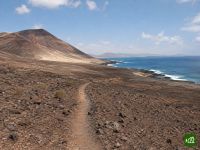
GR131 Lanzarote
About GR131 Lanzarote
A north to south crossing of Lanzarote, from the fishing village of Órzola along the cliffs of the Famara massif down to Playa Blanca. It links whitewashed villages, the palm valley of Haría and the lava vineyards of La Geria, over black volcanic ground within sight of the Atlantic.
GR131 Lanzarote map
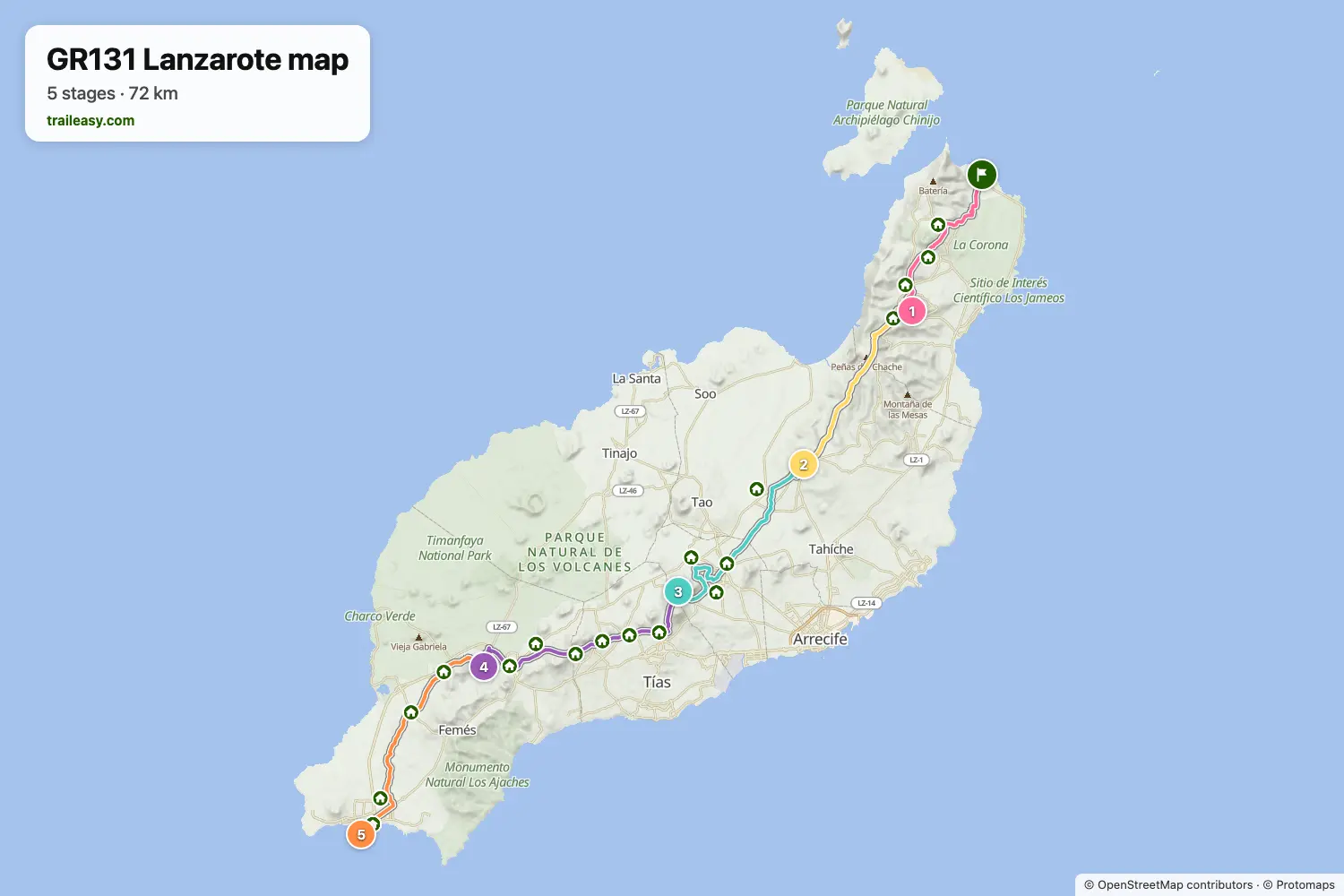
The interactive map shows the whole route, with accommodation, water and public transport along the way.
GR131 Lanzarote route planner
Build a day-by-day itinerary in the route planner, find accommodations along the route, and download the GPX file. Start from an example below or from scratch.
5-Day ItineraryShown below
A five day north to south crossing of Lanzarote, from the fishing village of Órzola along the cliffs of the Famara massif down to Playa Blanca. The walk links the palm valley of Haría, the old capital at Teguise and the black lava vineyards of La Geria, passing under the volcanoes of Timanfaya on open ground with the Atlantic almost always in view.
GR131 Lanzarote stages
5 days, 77 km and 1,660 m of ascent. These stages follow the 5-Day Itinerary. Open it in the route planner to split or merge days and choose where you sleep.
- Stage 112.9 km↑ 481 m · ↓ 212 m ·
4–5h with stopsTo Haría
Night at Villas Finca La Crucita BY PVL - Stage 213.5 km↑ 385 m · ↓ 357 m ·
4–5h with stopsHaría Teguise
Night at HOTEL BOUTIQUE PALACIO ICO - Stage 316.4 km↑ 288 m · ↓ 285 m ·
5–6h with stopsTeguise Mancha Blanca
Night at Ga7colores Lanzarote - Stage 417.6 km↑ 397 m · ↓ 510 m ·
5–6h with stopsThrough La Geria Yaiza
Night at Hotel La Casona de Yaiza - Stage 516.3 km↑ 109 m · ↓ 289 m ·
4–5h with stopsYaiza Playa Blanca
Best time to go
- Best time1 Oct – 30 Apr
- Good time1 May – 30 Jun, 1 Sept – 30 Sept
- Possible, with care1 Jul – 31 Aug
A winter trail. From October to April the walking is mild and the villages along the way stay open all year. Summer is the season to avoid, since there is nowhere to shelter from the sun between villages and the black volcanic ground radiates heat back. Spring and autumn work if you start early and finish by mid afternoon, and calima dust episodes can arrive in any month.
Frequently asked questions
When is the best time of year to walk the GR131 in Lanzarote?
November to March. On Lanzarote the wind decides more of your day than the temperature does. The northeast trades blow all year and are strongest along the Famara ridge, where they can strip the warmth out of a sunny afternoon and make a rest stop miserable. Summer is the stretch to avoid outright, since there is no shelter between villages and the black ground throws the heat back at you. Spring and autumn work if you start early and are finished by mid afternoon. Bear in mind that this is a holiday island, so the walking is quietest in winter while the beds are at their most expensive over Christmas and the February half term.
How many days do you need to walk the GR131 across Lanzarote?
Four to six days. Five is the most common split and gives days of a size that land you in a village each evening without a long afternoon in the sun. Strong walkers do it in four, though that means a couple of big days across the exposed middle of the island. Six suits anyone who wants to look at Haría, Teguise and the vineyards of La Geria properly rather than passing through them, and it leaves room for a short first day if you reach Órzola in the afternoon. Your day lengths are dictated mostly by where the villages fall rather than by the terrain, which is unusual and makes the planning simpler than it looks.
Is the GR131 Lanzarote a good first multi-day hike?
Yes, it is the gentlest of the Canary island crossings. There is far less climbing than on Tenerife, La Palma or Gran Canaria, the daily distances are moderate, and you finish in a village most nights instead of camping. What makes it demanding is exposure rather than gradient: long open stretches with no shade, a persistent wind, and a lot of loose volcanic ground underfoot. The Famara ridge is the one place where a head for heights helps, since the path runs close to a long drop. If you can walk comfortably for six or seven hours on consecutive days and you are happy carrying enough water, the terrain will not catch you out.
Where do you stay along the GR131 in Lanzarote?
In the villages the route runs through, which sets this island apart from the rest of the chain. Haría, Teguise, Uga and Yaiza all have small hotels or rural guesthouses, and Playa Blanca at the finish has plenty of choice. Beds are limited in the smaller places, so book ahead for the January to March peak and check where a guesthouse actually sits, since some are a walk off the trail. There are no mountain huts anywhere on the island, so any night that does not land in a village means either a tent or a taxi. The Traileasy planner attaches a place to each night as you build the route, so you can see whether a day finishes in Haría or has to push on to Teguise before you commit to anything.
Can you camp on the GR131 in Lanzarote?
Not freely. Camping outside authorised areas is prohibited on Lanzarote, and the island's designated camping grounds need a permit from the Cabildo, requested in advance and issued free. In practice the trail is laid out so that you do not need to camp at all, since the villages are spaced closely enough for the whole crossing to work bed to bed. Walkers who do pitch out keep it quiet and discreet, well back from the trail and off private ground, with nothing lit and no trace left, though that is tolerated rather than permitted and enforcement is real near protected areas. There is an official campsite near Papagayo at the southern end if you want one legal night under canvas, and it is worth confirming the current permit process before travelling, since the Cabildo has changed it more than once.
How much water do you need to carry on the GR131 Lanzarote?
Plan on three litres a day, and four on the longer or hotter stages. There are no springs or streams anywhere on the route, so every drop comes from taps, bars and shops in the villages, and the gaps between them are the thing to plan around. Fill up completely whenever you reach one rather than topping off, because the next reliable source may be most of a day away. Bars in Haría, Teguise, Uga and Yaiza are the dependable refill points, and most will fill a bottle if you buy something. The wind here is deceptive: it keeps you feeling cool while drying you out faster than the temperature suggests, which is how people get caught short.
How do you get to Órzola for the start and home from Playa Blanca?
Fly into Arrecife, then take a bus or taxi north to Órzola. Public buses run up the east coast and through Haría, but the service thins out in the evening, so check the timetable before committing to a late arrival. Playa Blanca at the southern end is well connected back to Arrecife and the airport by frequent buses, and being a resort town it is easy to find a bed for the final night. It is also the ferry port for Corralejo on Fuerteventura, a short crossing running several times a day, which is how walkers continue along the island chain. Leave a buffer day if you are flying out the same evening you finish.