
Everest Base Camp Trek
About Everest Base Camp Trek
The trek from the mountain airstrip at Lukla to Everest Base Camp, at the foot of the Khumbu Icefall, by way of the Sherpa villages of Namche Bazaar and Dingboche and the monastery at Tengboche, with a teahouse to sleep in every night. A side climb from Gorak Shep to Kala Patthar gives the view of Everest's summit that base camp itself does not have.
Everest Base Camp Trek map
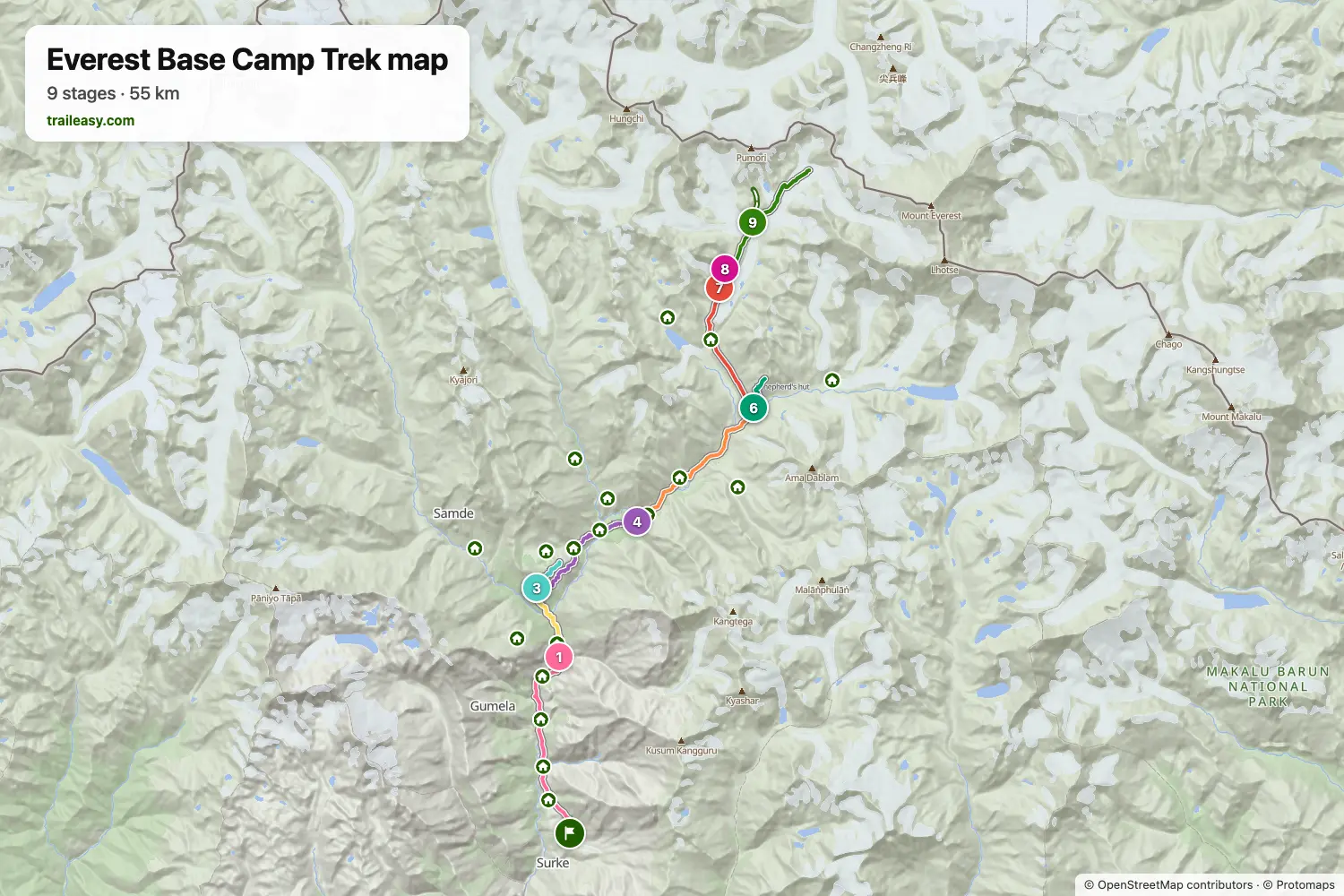
The interactive map shows the whole route, with accommodation, water and public transport along the way.
Everest Base Camp Trek route planner
Build a day-by-day itinerary in the route planner, find accommodations along the route, and download the GPX file. Start from an example below or from scratch.
Classic 13-Day EBC TrekShown below
A comprehensive 13-day itinerary to Everest Base Camp with two acclimatization days. This route follows the classic trail from Lukla through Namche Bazaar, Tengboche, Dingboche, and Lobuche to Gorakshep, from where you visit EBC. Includes days at Namche Bazaar and Dingboche for proper altitude acclimatization.
Straight to EBC
A 8-day itinerary to Everest Base Camp with two acclimatization days. This route follows the classic trail from Lukla through Namche Bazaar, Tengboche, Dingboche, and Lobuche to Gorakshep, from where you visit EBC. Includes days at Namche Bazaar and Dingboche for proper altitude acclimatization.
Everest Base Camp Trek stages
9 days, 73 km and 6,386 m of ascent. These stages follow the Classic 13-Day EBC Trek itinerary. Open it in the route planner to split or merge days and choose where you sleep.
- Stage 113.4 km↑ 870 m · ↓ 844 m ·
5–6h with stopsLukla Monjo
Night at Mount Kailesh Lodge and Restaurant - Stage 25.5 km↑ 879 m · ↓ 286 m ·
4–5h with stopsMonjo Namche Bazaar
Night at Hotel Sherpaland - Stage 35.2 km↑ 512 m · ↓ 512 m ·
3–4h with stopsNamche Bazaar Namche Bazaar
Night at Hotel Sherpaland - Stage 49.9 km↑ 1,119 m · ↓ 699 m ·
7–8h with stopsNamche Bazaar Tengboche
Night at The Himalayan Luxury Lodge Tyangboche - Stage 510.9 km↑ 935 m · ↓ 474 m ·
6–7h with stopsTengboche Dingboche
Night at Green Tara Lodge & Restaurant (Hotel) - Stage 64.8 km↑ 727 m · ↓ 727 m ·
4–5h with stopsDingboche Dingboche
Night at Green Tara Lodge & Restaurant (Hotel) - Stage 78.1 km↑ 688 m · ↓ 76 m ·
4–5h with stopsDingboche Lobuche
Night at Oxygen Restaurant Home - Stage 81.4 km↑ 78 m · ↓ 13 m ·
41m with stopsLobuche Pyramid Inn
Night at 8000 Inn pyramid lobuche - Stage 913.5 km↑ 578 m · ↓ 402 m ·
6–7h with stopsFrom Pyramid Inn
Best time to go
- Best time1 Mar – 31 May, 1 Oct – 30 Nov
- Good time16 Sept – 30 Sept
- Possible, with care1 Jun – 15 Sept, 1 Dec – 29 Feb
October to November and March to May are the two windows, autumn for the clearest mountain air of the year, spring for warmer days and the rhododendrons in flower. Late September is walkable but unreliable, since the monsoon withdraws around the start of October and Lukla flights are grounded by low cloud until then. From June to mid-September cloud hides the mountains, and December to February is clear and very cold with some Gorak Shep lodges shut.
Frequently asked questions
How many days do you need for the Everest Base Camp trek?
Plan on 12 to 14 days round trip from Lukla, including at least two acclimatization days. The walk in to base camp takes about eight days through Namche Bazaar, Tengboche, Dingboche and Gorakshep, with the return following the same trail and moving faster downhill. Adding the Gokyo Lakes over the Cho La Pass stretches it to roughly 15 to 18 days. Shorter itineraries exist, but they cut acclimatization time and sharply raise the risk of altitude sickness, so err toward more days rather than fewer. It is also worth holding a spare day for the Lukla flight, which is weather-dependent and often delayed. In the Traileasy planner you can set your own pace and drop extra rest days wherever you want them.
How difficult is the Everest Base Camp trek, and can a beginner do it?
The Everest Base Camp trek is strenuous but not technical, and a reasonably fit beginner can complete it. There is no climbing, scrambling or exposure on the way to base camp, just long days on well-made trails, often stone steps, linking one village to the next. What makes it hard is the mix of consecutive days and thin air: you walk five to six hours a day for around two weeks, much of it above 4,000 m where the air holds roughly half the oxygen of sea level. Altitude, not fitness, is what turns most people back, so pacing and acclimatization matter more than raw athleticism. A few months of regular cardio and some hikes carrying a loaded pack will make it far more comfortable. Prior high-altitude experience helps but is not required.
How high is Everest Base Camp, and how do you avoid altitude sickness?
Everest Base Camp sits at 5,364 m (17,598 ft), and the nearby viewpoint of Kala Patthar reaches 5,550 m. The altitude is the real challenge of the trek, since the air up there holds around half the oxygen of sea level. The way to avoid altitude sickness is to ascend slowly and build in acclimatization days, usually at Namche Bazaar and Dingboche, climbing higher during the day and sleeping lower. Drink plenty of water, do not rush the higher stages, and if symptoms like headache or nausea get worse, descend rather than push on. Teahouses along the route handle altitude sickness daily and can arrange a helicopter evacuation, so make sure your travel insurance covers rescue and trekking to 5,600 m. Building a slower profile into your itinerary is the single most effective thing you can do.
Do you need a guide, or can you trek to Everest Base Camp independently?
You do not need a guide, and Everest Base Camp is one of the most achievable Himalayan treks to do independently. Nepal introduced a nationwide rule in 2023 requiring a licensed guide in many trekking areas, but the Khumbu (Everest) region did not adopt it and runs its own local permit system instead, so independent trekking here remains legal. The trail is a busy, well-marked path between villages with no technical sections, and with an offline GPS map on your phone it is very hard to get lost. Going independently means arranging the two Khumbu permits, your Lukla flight and your teahouses yourself, which is straightforward and much cheaper than a guided package. The Traileasy planner maps every nightly stop along the route so you can see exactly where to book. Rules can change between seasons, so confirm the current guide requirement before you travel.
What permits do you need for the Everest Base Camp trek?
You need two permits for Everest Base Camp: the Khumbu Pasang Lhamu Rural Municipality permit (around $15) and the Sagarmatha National Park entry permit (around $25 to $30). Together they come to roughly $45, and no TIMS card is required in the Khumbu. You can buy the national park permit in Kathmandu, and both are available on the trail, with many trekkers picking them up at the checkpoint in Monjo on the way in. Buying them yourself takes only a few minutes and needs no guide or agency. Prices are set in Nepalese rupees and change over time, so treat these as a guide and carry both permits to show at checkpoints. Our Everest Base Camp trip report shows what we paid at the Monjo counter.
How do you get to the start of the trek at Lukla?
The trek starts in Lukla, a mountain village reached by a short flight from Kathmandu. In the busy spring and autumn seasons these flights usually leave not from Kathmandu but from Ramechhap (Manthali), a four to five hour drive away, with most trekkers taking a shared pre-dawn transfer to catch the early departures. Outside peak season, direct Kathmandu to Lukla flights often run. The flights are highly weather-dependent and delays or cancellations of a day or more are common, so build a spare day or two into both ends of your trip. You can book tickets directly with the airlines, such as Tara Air. From Lukla it is about an eight-day walk to base camp through Namche Bazaar, Tengboche, Dingboche and Gorakshep.
What does the Everest Base Camp trek cost?
Trekking independently, budget roughly $600 to $1,200 for the trek itself, excluding international flights and gear. That covers about $45 in permits, a round-trip Lukla flight of $350 to $450, teahouse rooms at $4 to $8 a night and food at around $25 to $40 a day. Costs climb the higher you go, and the extras such as hot showers, wifi, charging and endless pots of tea add up. A guided package typically runs $1,400 to $3,000 or more, so organizing it yourself is far cheaper. Everything on the trail is cash only in Nepalese rupees, so bring enough from Kathmandu since mountain ATMs are unreliable.