
Camino de Santiago (Camino Fisterra-Muxía)
About Camino de Santiago (Camino Fisterra-Muxía)
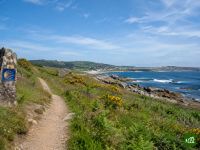
The epilogue to the Camino de Santiago, walked from the cathedral city out to the Atlantic. It crosses the quiet hills of inland Galicia to the fishing town of Fisterra, long held to be the end of the known world, then follows the Costa da Morte north to the seafront sanctuary at Muxía.
Camino de Santiago (Camino Fisterra-Muxía) map
The interactive map shows the whole route, with accommodation, water and public transport along the way.
Camino de Santiago (Camino Fisterra-Muxía) route planner
Build a day-by-day itinerary in the route planner, find accommodations along the route, and download the GPX file. Start from an example below or from scratch.
6-Day ItineraryShown below
From the cathedral in Santiago to the sea at Fisterra and on to Muxía, with the two long stages split so no day runs much longer than the others. The first night is in Negreira. The next two, at Santa Mariña and at O Logoso near Hospital, break up the long rural stretch past Olveiroa. Day four comes down to the coast at Cee and Corcubión. Day five walks through Fisterra and on to Lires, and the last morning follows the Costa da Morte to Muxía.
Camino de Santiago (Camino Fisterra-Muxía) stages
6 days, 114 km and 2,386 m of ascent. These stages follow the 6-Day Itinerary. Open it in the route planner to split or merge days and choose where you sleep.
- Stage 120.8 km↑ 495 m · ↓ 596 m ·
7–8h with stopsTo Negreira
Night at Hotel Millán - Stage 221.6 km↑ 534 m · ↓ 362 m ·
7–8h with stopsNegreira Santa Mariña
Night at Albergue Casa Pepa - Stage 316.6 km↑ 296 m · ↓ 336 m ·
5–6h with stopsSanta Mariña O Logoso
Night at Albergue O Logoso - Dumbría - Stage 417.5 km↑ 208 m · ↓ 481 m ·
5–6h with stopsO Logoso Corcubión
Night at Casa da Balea - Stage 523.4 km↑ 536 m · ↓ 533 m ·
7–8h with stopsCorcubión Lires
Night at LiresCa Hotel Restaurante - Stage 614.5 km↑ 317 m · ↓ 331 m ·
4–5h with stopsLires Muxía
Best time to go
- Best time1 May – 30 Sept
- Good time1 Mar – 30 Apr, 1 Oct – 30 Nov
- Possible, with care1 Dec – 29 Feb
Walkable all year, and best from May to September. May is no drier than April but warmer and sunnier, and June to September are the driest months, warm rather than hot, with July and August the busiest. March and April are cooler, and in October and November the heavy rain returns. From December to February the public albergues and many private ones stay open, but daylight is shortest, so start the long Negreira to Olveiroa stage at first light.
Frequently asked questions
When is the best time to walk from Santiago to Fisterra and Muxía?
May to September. What sets May apart from April is warmth and sunshine rather than rain: on the long-term record at Santiago airport, at the inland end of the route, May gets nearly as much rain as April but is a couple of degrees warmer and sunnier. June to September are the driest months, and the nearness of the sea keeps the summer warm rather than hot. July and August are also the busiest. October still feels mild, but on average it is wetter than January, and the heavy rain carries on through November. Nothing closes in winter. The public albergues and many private ones stay open all year, so a December walk works with good waterproofs and starts at first light.
How many days does it take to walk from Santiago to Fisterra and on to Muxía?
Four or five days, the same range the Xunta and the Gronze guide give for reaching both towns. The first day, from Santiago to Negreira, is a gentle start. The second, on to Olveiroa, is the longest of the walk, rural and hilly, and anyone who wants it shorter can stop at Vilaserío or Santa Mariña, which both have albergues. From Olveiroa it is one long day to Fisterra, or two with a night in Corcubión, and the coastal stage on to Muxía takes another full day, with Lires at its halfway point. That makes four days at a strong pace and five or six at an easier one, plus a couple of hours for the walk out to the lighthouse and back. Fisterra on its own takes three or four days. Muxía alone, by the direct branch, takes three.
Is Finisterre the same as Fisterra, and does the Camino end in the town or at the lighthouse?
Yes, they are the same place. Fisterra is the Galician name, the one the Xunta and the town council use, and Finisterre is the Spanish form, after the Roman finis terrae, the end of the known world. The Camino ends at the lighthouse on the cape: the Xunta's stage list for the Muxía-first route finishes at Faro Fisterra, and the Gronze guide counts the walk from the town out to the lighthouse as a short final stage of its own. If you go to Fisterra first, the official route turns for Muxía from the town itself, so the cape becomes a there-and-back. It is an uphill walk of under an hour each way, most of it on the shoulder of the lighthouse road. Everything practical stays in town: the pilgrim albergue, the Fisterrana and the path on to Muxía. Traileasy loads the walk to the lighthouse as a side trip, Cabo Fisterra, out and back from the town, so the stage on to Muxía starts where the official one does.
Should you walk to Fisterra or Muxía first, and is it worth doing both?
Either order works, and the Xunta publishes the route both ways. The choice comes soon after Olveiroa, at a roundabout beyond Hospital, where a waymark sends the Muxía branch to the right and the main line carries on towards Cee and Fisterra. The Muxía branch is the quieter of the two, and going that way first lets you finish at the lighthouse in Fisterra, which is where the Xunta's Muxía-first route ends. Fisterra first leaves Muxía and its sanctuary of the Virxe da Barca as the last stop. The coastal day between the two towns is waymarked in both directions, so it works either way round. Doing both costs one more day, and the Xunta itself calls the walk between them a must. Traileasy's route goes to Fisterra first and on to Muxía, and the direct branch from Hospital is a variant, Hospital a Muxía, for a walk that heads straight for Muxía and leaves Fisterra out.
Do you need to book albergues on the way to Fisterra and Muxía?
You cannot book the public albergues at all, and the private ones are worth booking mainly for July and August and around Easter. The public albergues at Negreira, Olveiroa, Dumbría, Fisterra and Muxía take no reservations: under the Xunta's rules, beds go to pilgrims in order of arrival, walkers ahead of cyclists, for one night only, and the doors open in the early afternoon. Private albergues, pensions and casas rurales do take bookings. Even on the Muxía branch there are beds at Hospital, Dumbría, A Grixa, Quintáns, Merexo and Moraime, and Lires, halfway along the coastal stage, has several places to stay. Outside the busy weeks, booking is mostly for the nights you want a particular bed. In winter, check that a private albergue is open before you count on it, since many stay open all year but not all of them do.
Do you get a Compostela or another certificate for walking to Fisterra and Muxía, and where do you collect it?
Not a Compostela. The Pilgrim's Office in Santiago issues it for a walk whose final stage leads into the cathedral, so walking out from Santiago to the coast does not count. The two towns have certificates of their own instead. The Fisterrana is issued by the Concello de Fisterra at the municipal pilgrim albergue and the tourist office in town, against the stamps in your credencial, and groups of more than ten need to contact the office or the albergue first. Muxía's council also certifies the pilgrimage, according to the Xunta, with what is known as the Muxiana. Pilgrim guides place it at the tourist office and the municipal albergue, and some name private albergues too, but the council does not confirm where, so ask at the albergue or the tourist office when you arrive. Either way, keep getting your credencial stamped after Santiago, at churches, albergues and other places along the way, and if it is already full, the Pilgrim's Office will give you a new one before you set out.
How do you get back to Santiago from Fisterra or Muxía?
By bus. Fisterra has several buses a day to Santiago and to A Coruña, and Muxía also has a regular service to Santiago. The two towns are linked by bus as well, with a change in Cee, which helps if you walked to one and want to see the other without walking back. Timetables are on bus.gal, the Xunta's public transport site, so check them the day before you finish.