
Ala-Kul Trek
Also known as Ala-Köl
About Ala-Kul Trek
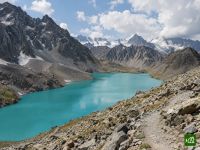
A trek from Karakol into the Terskey Ala-Too, a range of the Tian Shan in Kyrgyzstan. It climbs through the spruce forests of the Karakol Gorge to Ala-Kul, a turquoise glacial lake beneath icy peaks, crosses the Ala-Kul pass on steep, loose scree and descends past summer pastures to the hot springs of Altyn Arashan, ending in the village of Ak-Suu. Nights are spent in yurt camps and guesthouses, or in a tent beside the lake.
Ala-Kul Trek map
The interactive map shows the whole route, with accommodation, water and public transport along the way.
Ala-Kul Trek route planner
Build a day-by-day itinerary in the route planner, find accommodations along the route, and download the GPX file. Start from an example below or from scratch.
3-Day ItineraryShown below
The classic three-day crossing from the Karakol Gorge to the village of Ak-Suu, walked in the direction that takes the steep side of the pass downhill. The first day follows the gorge up through spruce forest to the yurt camps at Sirota. The second is the big one: up to the turquoise Ala-Kul lake, over the Ala-Kul pass and down the steep, loose descent into the Keldike valley to the hot springs of Altyn-Arashan. The last day follows the track down the Arashan valley to Ak-Suu.
Ala-Kul Trek stages
3 days, 50 km and 2,314 m of ascent. These stages follow the 3-Day Itinerary. Open it in the route planner to split or merge days and choose where you sleep.
- Stage 119.2 km↑ 1,111 m · ↓ 86 m ·
7–8h with stopsUp the Karakol Gorge Sirota
Night at Nomad Camp - Stage 215.1 km↑ 1,035 m · ↓ 1,468 m ·
9–10h with stopsOver the Ala-Kul pass Altyn-Arashan
Night at Guest House Elza - Stage 315.6 km↑ 168 m · ↓ 805 m ·
5–6h with stopsDown Ak-Suu
Best time to go
- Best time16 Jul – 15 Sept
- Good time1 Jul – 15 Jul
- Possible, with care16 Jun – 30 Jun, 16 Sept – 30 Sept
Mid-July to mid-September is the reliable time, with the Ala-Kul pass clear and the yurt camps open. Snow lies on the pass into early July, and in late June only some camps are up and microspikes are advisable. Afternoon thunderstorms are common all summer, and the yurts fill up in July and August, so book ahead. In the second half of September the camps pack up and fresh snow can fall on the pass, so carry a tent, your own food and microspikes.
Frequently asked questions
How many days does the Ala-Kul trek take, and how long is it?
Three days is what most people walk, though four is easier on the body. On the three-day plan you sleep at Sirota yurt camp in the Karakol Gorge, then climb to the lake, cross the pass and descend to Altyn Arashan in one very long day, before walking out to Ak-Suu on the third. The four-day version adds a night beside Ala-Kul. That splits the big day in two, at the price of a cold night in a tent at altitude. With a 4x4 at one or both ends, two days is possible. Published lengths differ because people start and finish in different places. Some walk in from the national park gate, others take a taxi to the first or second bridge, and many ride a jeep out of Altyn Arashan rather than walk the track to Ak-Suu. A day trip by jeep reaches the lake and comes back the same way, without crossing the pass.
Is the Ala-Kul trek difficult, and can you do it without a guide?
It is a demanding trek, and the altitude is the main reason. The lake lies at around 3,550 m and the Ala-Kul pass above it at about 3,900 m, high enough for headaches and breathlessness if you arrive straight from the lowlands. A few days in Kyrgyzstan beforehand help, and the night at Sirota is a useful step up. The hardest ground is the far side of the pass: a steep slope of loose scree that most people half walk and half slide down, with poles and care. Nothing on the route is technical. You do not need a guide, and very few independent walkers hire one, because the path is well used in summer and mostly easy to follow. It does fade in places, though, and on a quiet day there may be nobody ahead to follow. For a first trek at this height, a guide is the safer choice. If you plan the crossing in Traileasy, the app keeps that line on an offline map on your phone, and a GPX export puts the same track on a watch for the descent into the Keldike valley.
Do you need a tent for the Ala-Kul trek, or can you sleep in yurts?
No, the classic three-day version needs no tent. The first night is at Sirota yurt camp, in the forest below the lake, where a bed in a shared yurt comes with dinner and breakfast. The second is in Altyn Arashan, which has guesthouses and yurt camps of its own, and there are more yurts in the Keldike valley below the pass. A tent only comes in if you sleep at the lake. There are no yurts there, just tent camps on the plateau above the shore, which charge a small fee to pitch your own. Pre-pitched tents at the lake can be reserved through CBT Karakol, and tents and sleeping bags can be rented in town. Group tours book out many of the yurts, so reserve Sirota before you set off, through a Karakol hostel or online. Laying the stages out in the Traileasy planner settles the three or four day question before you book anything: night one lands either at Sirota or beside the lake, and only the lake night needs a tent.
Do you need a permit for the Ala-Kul trek, and what are the park fees?
No permit is needed, but you pay a park fee twice. The first is at the Karakol valley gate on the way in, reported at 250 to 300 som per person in recent seasons. The second is collected at the checkpoint on the Ak-Suu side as you leave the Arashan valley, at around 200 som. Some walkers also report a small extra charge for a tent. No official tariff is published online, so treat these amounts as a guide. Carry cash in small notes, because change at the gate is not guaranteed and there are no ATMs beyond Karakol.
How do you get to the start of the Ala-Kul trek, and which direction should you walk it?
Base yourself in Karakol, about six hours from Bishkek by GoBus or shared marshrutka, and walk from the Karakol Gorge to Ak-Suu. Marshrutka 101 runs from Karakol to the national park entrance for a few som. From there a long gravel road leads up the gorge, so most people share a taxi to the first bridge, or a 4x4 to the second, which spares hours of road walking. Hostels in Karakol and CBT Karakol can arrange the ride. The direction matters. Walking up the Karakol Gorge, the climb to the lake is gradual, and the steep, loose north side of the pass is something you come down. Reversed, that same slope becomes a long, punishing climb out of Altyn Arashan.
How do you get back to Karakol from Altyn Arashan, and is it worth walking down to Ak-Suu?
Walk if you have the time. The way out follows the jeep track down the Arashan valley, downhill nearly all the way, to a bus stop just before Ak-Suu, a village still called Teploklyuchenka on some maps. From there marshrutka 350 runs to Karakol for a few dozen som. It keeps no fixed timetable and leaves when full, so a taxi is the fallback late in the day. The alternative is a 4x4 straight from Altyn Arashan, reported at around 8,000 som per vehicle to Ak-Suu and up to 12,000 som through to Karakol, shared by up to four people. That makes sense when you can fill it and need to be in Karakol the same evening. Seats on a jeep leaving at dusk are not guaranteed in peak season, so arrange it with your guesthouse the night before. On the three-day plan you sleep there anyway, and the hot springs are the reason to: most guesthouses have their own pool, booked in short time slots, and some include it for overnight guests.
Where do you get drinking water on the Ala-Kul trek, and do you need to treat it?
From the streams and rivers beside most of the route, and yes, treat it. Livestock graze these valleys, so carry a filter or purification tablets and use them on every refill. Three stretches have no easy water. The first is the steady climb from the second bridge up to Sirota. The second runs from the lake over the pass to the foot of the steep descent, and the third is the first hour or so out of Altyn Arashan. Fill up before each one. The yurt camps serve boiled water and tea with meals, and shops in Altyn Arashan sell bottled water at a steep price.