
Ghorepani Poon Hill Trek
About Ghorepani Poon Hill Trek
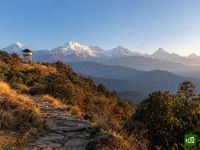
A short teahouse loop in the Annapurna foothills above Pokhara. From Birethanti it climbs long stone staircases to Ulleri and goes on through rhododendron forest to Ghorepani, where a pre-dawn climb up Poon Hill gives a sunrise view of Dhaulagiri, the Annapurnas and Machapuchare. It then follows the forested ridge to Tadapani and comes down through the Gurung village of Ghandruk to Birethanti.
Ghorepani Poon Hill Trek map
The interactive map shows the whole route, with accommodation, water and public transport along the way.
Ghorepani Poon Hill Trek route planner
Build a day-by-day itinerary in the route planner, find accommodations along the route, and download the GPX file. Start from an example below or from scratch.
4-Day ItineraryShown below
A four-day loop from Birethanti. The first day climbs the long stone staircases to Ulleri, and the second goes on through rhododendron forest to Ghorepani. On the third morning a pre-dawn climb up Poon Hill gives sunrise over Dhaulagiri and the Annapurnas, then the trail crosses the forested ridge past Deurali and Tadapani and drops to the Gurung village of Ghandruk. The last day comes down past Kimche and Syauli Bazaar to Birethanti.
Ghorepani Poon Hill Trek stages
4 days, 45 km and 3,382 m of ascent. These stages follow the 4-Day Itinerary. Open it in the route planner to split or merge days and choose where you sleep.
- Stage 19.0 km↑ 1,229 m · ↓ 226 m ·
4–5h with stopsBirethanti Ulleri
Night at Holiday Guest House & Restaurant - Stage 28.2 km↑ 1,017 m · ↓ 178 m ·
3–4h with stopsUlleri Ghorepani
Night at The Sunny Hotel - Stage 317.6 km↑ 957 m · ↓ 1,850 m ·
8–9h with stopsPoon Hill sunrise, then via Tadapani Ghandruk
Night at HOTEL ROCK & MUD - Stage 410.7 km↑ 179 m · ↓ 1,130 m ·
4–5h with stopsGhandruk Birethanti
Best time to go
- Best time1 Mar – 31 May, 1 Oct – 30 Nov
- Good time16 Sept – 30 Sept, 1 Dec – 29 Feb
- Possible, with care1 Jun – 15 Sept
The best months are October and November, for the clearest air at sunrise, and March to May, when the rhododendrons around Ghorepani flower. Ghorepani's lodges fill in October and on spring weekends. The monsoon, from June to mid-September, brings leeches, landslides on the road and cloud over the peaks most mornings, so keep a spare day. December to February is mostly clear, with cold nights and at times snow or ice on the steps up Poon Hill.
Frequently asked questions
How many days do you need for the Poon Hill trek, and how long is it?
Most people walk the loop in four days, and three to five covers almost every itinerary. The usual shape is two days up from Birethanti through Ulleri to Ghorepani, the Poon Hill sunrise on the third morning, then the forest ridge to Tadapani and a last day down through Ghandruk. You can fit it into three by taking a jeep to Hile at the start. Five gives an easier pace and a night in Ghandruk, a large Gurung village that deserves more than a lunch stop. Whatever the length, sleep in Ghorepani the night before the sunrise. It is a short trek by Himalayan standards. None of the days is long in distance, but most of them climb or drop steeply on stone steps.
How hard is the Poon Hill trek, and how high does it go?
It is a moderate trek with no technical ground, and its high point, Poon Hill, stands at 3,210 m. The hard part is the stone staircase up to Ulleri. It has more than three thousand steps and hardly levels out, so that is the day that tests your legs. Altitude matters less. Ghorepani, where you spend your highest night, lies just below the summit: high enough for a mild headache or a restless night, but low enough that serious altitude sickness is rare. If a headache gets worse instead of better, skip the sunrise climb and go down. Beyond Ghorepani the path rises and falls through forest, and the descents to Tadapani and Ghandruk are long and hard on the knees. Anyone who walks regularly and is happy with several days of steps can do it, and plenty of families choose it as their first Himalayan trek.
Do you need a guide or permits for the Poon Hill trek?
Officially you need both. Under the revised TIMS rules in force since 31 March 2023, the Nepal Tourism Board lists the Poon Hill-ABC trek among the Annapurna routes where foreign trekkers need a licensed guide and a TIMS card issued through a trekking agency. You also need the Annapurna Conservation Area entry permit, which costs NPR 3,000 for foreigners or NPR 1,000 for SAARC nationals if you buy it in advance, online through NTNC or at the counter in Kathmandu or Pokhara. At a check-post on the trail it costs double. The TIMS card adds NPR 2,000, or NPR 1,000 for SAARC citizens, and the agency arranges it with your guide. Enforcement is another matter. Trekkers reporting from Annapurna checkpoints since 2023 describe staff logging names and permits without asking about a guide. That is a gap in how the rule is applied, not a change to it. Fees and checks can both shift between seasons, so ask an agency in Pokhara how things stand before you set off.
How do you get to the start of the Poon Hill trek from Pokhara, and which way round should you walk it?
Start at Birethanti, a short walk or jeep ride from Nayapul on the Pokhara to Baglung highway, and walk the loop clockwise unless you have a reason not to. Local buses to Nayapul leave from Pokhara's Baglung bus park and take about two hours. A taxi or private jeep is quicker, and jeeps can carry on up the valley if you would rather skip the first climb. Your conservation area permit is checked at Birethanti. Going clockwise, the usual direction, you climb the long staircase to Ulleri early, reach Ghorepani for the sunrise and come down through Tadapani and Ghandruk. Walked anticlockwise, the loop climbs through Ghandruk and Tadapani instead and leaves the staircase for the final day, as a long descent that punishes tired knees. Both arms now have jeeps near the bottom, so getting back to Pokhara is simple whichever way you finish.
Can you drive to Ghorepani now, and how much of the Poon Hill trek is on roads?
Yes. Since autumn 2025 a rough road has run from Nayapul through Birethanti and Ulleri all the way to Ghorepani, and by spring 2026 the Nepali press was reporting buses from Pokhara to the village. On the classic loop through Ghandruk, roughly a third of the route is now on road: in the valley between Birethanti and Hile, on the final climb into Ghorepani, and around Ghandruk and Kimche on the way down. The forest ridge from Ghorepani over Deurali to Tadapani has no road at all, and the footpath carries on without one down to the edge of Ghandruk. If you are short of time, ride up and walk that part. The road can slide after heavy rain, so leave a spare day if your plan depends on a vehicle. The jeep road and the stone path meet and part more than once. The Traileasy app keeps your route on an offline map with your position on it, so one glance shows if you are on the road or the path.
What time do you leave Ghorepani for the Poon Hill sunrise, and do you pay to go up?
Leave about an hour before sunrise, which means a headlamp start somewhere between four and six in the morning, depending on the time of year. The climb is stone steps through the forest all the way and takes 45 minutes to an hour. Poon Hill is only a viewpoint. You sleep in Ghorepani below and come back down afterwards. An entry fee is collected for the hill and tea stalls at the top sell hot drinks, so carry some rupees in cash. It is cold up there before dawn, so take a warm layer and gloves. Cloud usually builds as the valleys warm, so the first hour of light tends to give the clearest view of the day. In Traileasy the climb is a separate route variant called Poon Hill summit, and the main loop leaves it out until you switch it on.
Can you combine Poon Hill with the Annapurna Base Camp trek?
You can, by leaving this loop at Tadapani and walking on to Chhomrong instead of down to Ghandruk. At Chhomrong you join the main trail up the Modi Khola into the Annapurna Sanctuary. On the way out you can take the shorter route back to the road through Jhinu Danda. The combination adds two or three days to the Annapurna Base Camp trek, and the same conservation area permit covers the whole trip. It also works in reverse. Walk up to the sanctuary first and save the sunrise for the end. Doing Poon Hill first means you see the Annapurnas from a distance before you walk in among them.