
Dolomiti di Brenta Trek
About Dolomiti di Brenta Trek
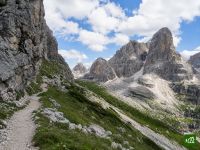
A circuit right around the Brenta Dolomites, the limestone group standing apart to the west of the main chain in Trentino. On one side it threads historic mountain huts beneath sheer towers and cabled passes, on the other it drops to quiet pastures and working malghe in the heart of brown bear country.
Dolomiti di Brenta Trek map
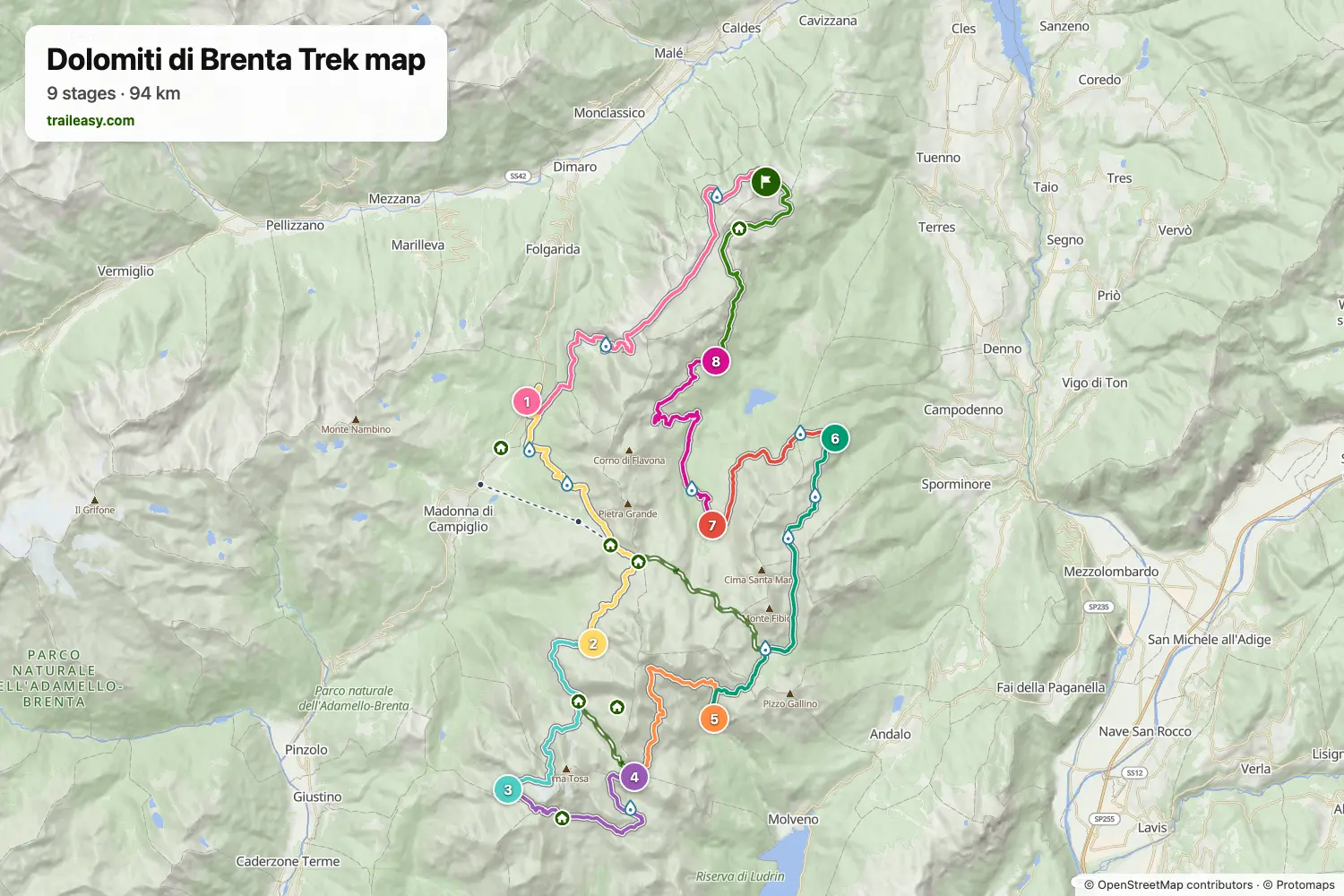
The interactive map shows the whole route, with accommodation, water and public transport along the way.
Dolomiti di Brenta Trek route planner
Build a day-by-day itinerary in the route planner, find accommodations along the route, and download the GPX file. Start from an example below or from scratch.
9-Day ItineraryShown below
A full hut-to-hut circuit of the Brenta Dolomites, starting and finishing at Rifugio Peller on the northern rim. The route drops to Madonna di Campiglio before climbing into the heart of the range, linking Rifugio Tuckett e Sella, Dodici Apostoli and Tommaso Pedrotti beneath the great limestone towers, with the via ferrata country of the Bocchette all around. The northern half is quieter and greener, working back through Molveno's forests and the high pastures of the Val di Tovel past a string of working malghe. Short days, but sustained climbing on every one of them.
Dolomiti di Brenta Trek stages
9 days, 100 km and 7,366 m of ascent. These stages follow the 9-Day Itinerary. Open it in the route planner to split or merge days and choose where you sleep.
- Stage 118.4 km↑ 997 m · ↓ 1,434 m ·
7–8h with stopsRifugio Peller Madonna di Campiglio
Night at Hotel Genzianella - Stage 213.8 km↑ 1,098 m · ↓ 391 m ·
5–6h with stopsMadonna di Campiglio Rifugio Tuckett e Sella
Night at Rifugio Tuckett e Sella - Stage 39.7 km↑ 952 m · ↓ 723 m ·
4–5h with stopsRifugio Tuckett e Sella Rifugio Dodici Apostoli
Night at Rifugio Dodici Apostoli - Stage 49.3 km↑ 760 m · ↓ 764 m ·
4–5h with stopsRifugio Dodici Apostoli Rifugio Tommaso Pedrotti
Night at Rifugio Tommaso Pedrotti - Stage 59.1 km↑ 378 m · ↓ 1,418 m ·
4–5h with stopsRifugio Tommaso Pedrotti Croz dell'Altissimo
Night at Croz of the Altissimo - Lodge - Stage 613.1 km↑ 1,364 m · ↓ 1,026 m ·
6–7h with stopsCroz dell'Altissimo Malga Loverdina
Night at Malga Loverdina - Stage 76.8 km↑ 316 m · ↓ 240 m ·
2–3h with stopsMalga Loverdina Malga Flavona
Night at Malga Flavona - Stage 811.0 km↑ 841 m · ↓ 961 m ·
5–6h with stopsMalga Flavona Malga Tuena
Night at Malga Tuena - Stage 99.1 km↑ 660 m · ↓ 410 m ·
3–4h with stopsMalga Tuena Rifugio Peller
Best time to go
- Best time1 Jul – 15 Sept
- Possible, with care16 Jun – 30 Jun, 16 Sept – 30 Sept
July to mid-September is the season, with the refuges open along the high traverse. They only start around 20 June, and before that there is nowhere to sleep high up, while snow in the passes and couloirs makes the exposed ground slower than the grade suggests. From the middle of September the refuges begin closing for the year.
Frequently asked questions
How many days do you need for the Dolomiti di Brenta Trek?
Six days is the usual minimum for the full loop, and strong hikers sometimes link it in five. Most walkers are better served by seven to nine, which leaves room for the long climbs and for weather. The circuit divides naturally in half. The northern section is straightforward walking and takes about three nights, while the southern half is the technical part and needs four. Plenty of people walk only one half and come back for the other, which is a sensible way in if the exposed sections worry you. Daily distances are short by Alpine standards, but the ascent on each stage is what sets the pace.
Do you need via ferrata experience and equipment for the Dolomiti di Brenta Trek?
Not for the whole route, but you do for one section. A helmet, harness and via ferrata lanyard are compulsory on the Castiglioni route through the southern Brenta, and that is the stretch most people mean when they call this trek technical. Everywhere else the protected sections are short and cabled rather than sustained. If you would rather avoid the hard ground entirely, marked alternatives drop onto easier terrain and rejoin the main circuit later. Snow can linger on the high passes into early July, so ask the refuges whether crampons or an axe are worth carrying before you set off. The Traileasy planner carries the Bocca di Brenta and Passo della Gaiarda variants, so you can build the trek with the easier line already in place and see where it rejoins.
When is the best time to hike the Dolomiti di Brenta Trek?
July to the middle of September. The limiting factor is not the huts but the bocchette: the cabled traverses can still be iced or choked with snow when the refuges have already opened, and a section that is straightforward in August is a different proposition in late June. Check the current state of the specific bocchette on your route rather than the season as a whole. Early September is the pick if you can take it, with the cables clear, the weather still settled and August's crowds gone. Opening and closing dates move each year with the snowpack, so confirm them with the individual refuges.
Is the Dolomiti di Brenta Trek the same as the Dolomiti di Brenta Trail?
No. They share a name and a mountain range, and nothing else. The Dolomiti di Brenta Trail is a one day trail running race based in Molveno, with three timed courses and around a thousand competitors, and it sells out well ahead. The Dolomiti di Brenta Trek is the multi day walking circuit of the whole massif, staying in mountain refuges along the way. If a search result offers you a start list, a time limit or a registration fee, you have landed on the race. Worth knowing too that the trek's own waymarking distinguishes an Expert line, which is the high route described here, from gentler valley walking nearby.
Do you need to book the rifugi on the Dolomiti di Brenta Trek in advance?
Yes, though with less panic than the busier Dolomites circuits. The Brenta sees a fraction of the traffic of the Alta Via routes, so a solo walker or a pair can often find beds a few weeks out. Weekends and the whole of August are the exception and fill early, sometimes months ahead. Book those as soon as the refuges open their season, usually in spring. Ring or email rather than relying on a booking form, since several of the huts still confirm by phone. Setting the route out night by night in the Traileasy planner shows which refuge each stage actually ends at, so you can work down the list in order instead of guessing.