
Carros de Foc
Also known as Carros de Fuego
About Carros de Foc
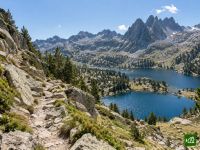
Carros de Foc is the hut-to-hut circuit of the Aigüestortes i Estany de Sant Maurici National Park in the Catalan Pyrenees, linking all nine of the park's staffed refuges. It strings together high granite passes between valleys full of lakes, as often over boulders and scree as on a path, and passes beneath the Encantats, the twin peaks above the lake of Sant Maurici.
Carros de Foc map
The interactive map shows the whole route, with accommodation, water and public transport along the way.
Carros de Foc route planner
Build a day-by-day itinerary in the route planner, find accommodations along the route, and download the GPX file. Start from an example below or from scratch.
5-Day ItineraryShown below
A five-day round of the Carros de Foc, walked clockwise from the Refugi d'Estany Llong and sleeping in a staffed refuge every night, with the other four refuges reached during the day. It sets off straight over the Coll de Contraix, the highest pass of the round, and down to Ventosa i Calvell. The second day crosses the Coll de Tumeneia to the Restanca and goes over the Port de Caldes into the lake basin of Colomèrs. The third crosses the Coll de Sendrosa to Saboredo and the Port de Ratera to Amitges. The fourth drops to the shore of the Estany de Sant Maurici beneath the Encantats, passes the Refugi Ernest Mallafré and climbs the Collada de Monestero to Josep Maria Blanc. The last crosses the Collada de Saburó, passes Colomina and comes over the Collada de Dellui back down to Estany Llong.
Carros de Foc stages
5 days, 64 km and 4,680 m of ascent. These stages follow the 5-Day Itinerary. Open it in the route planner to split or merge days and choose where you sleep.
- Stage 18.9 km↑ 924 m · ↓ 701 m ·
4–5h with stopsRefugi d'Estany Llong Refugi Ventosa i Calvell
Night at Refugi Ventosa i Calvell - Stage 212.9 km↑ 1,135 m · ↓ 1,208 m ·
6–7h with stopsRefugi Ventosa i Calvell Refugi de Colomèrs
Night at Refugi de Colomers - Stage 310.7 km↑ 880 m · ↓ 651 m ·
4–5h with stopsRefugi de Colomèrs Refugi d'Amitges
Night at Refugi amitges - Stage 413.8 km↑ 878 m · ↓ 928 m ·
5–6h with stopsRefugi d'Amitges Refugi Josep Maria Blanc
Night at Refugi J M Blanc - Stage 517.9 km↑ 863 m · ↓ 1,196 m ·
7–8h with stopsRefugi Josep Maria Blanc Refugi d'Estany Llong
Best time to go
- Best time1 Jul – 25 Sept
- Possible, with care6 Jun – 30 Jun, 26 Sept – 12 Oct
The refuges are guarded from early June, and July to late September is the time to go, when the whole round can be booked as one. Early in the season snow lies on the high cols and guides may ask for crampons and an ice axe, so check with the refuge guardians. In July and August the refuges fill well ahead; September is quieter but colder. After 25 September only some refuges stay open, until around 12 October.
Frequently asked questions
When is the best time to do Carros de Foc, and is there still snow in June?
Go between July and late September. The whole round stays in high mountain country, among granite cols where snow can linger after the refuges open, so June calls for care rather than being ruled out. One local guiding company warns that early in the summer you may need crampons, an ice axe, a helmet and a harness for short stretches, depending on how much snow is left on the passes. The refuge guardians know the state of the next col better than any forecast. Ask where you sleep. At the other end of the season, the booking office only takes nights between early June and late September (6 June to 25 September in 2026), and only some refuges stay open into October. In winter the passes are under snow and the round is done on skis, which is a different trip altogether. Check each year's dates before you plan.
How many days does Carros de Foc take, and can you do it in three or four days?
Plan on five to seven days, which is what the organisers recommend for the classic round of nine refuges. Four days works for fit walkers: the official guides run a four-day trip alongside their five and six-day ones, and even the five-day version has long, demanding stages. Anything shorter turns into a running challenge. The route grew out of the refuge guardians visiting one another, some of them going all the way round in under a day, and the non-stop Sky Runner record is below ten hours. The national park recommends at least four days. Because you can start at any refuge and walk either way round, your stages fall wherever you choose to sleep. In the Traileasy planner you can lay the round out refuge by refuge and compare a four-day plan with a six-day one before you book a single night.
How long is Carros de Foc, and why do sources disagree on the distance and the climbing?
The organisers give 65 km, while the Catalan and Spanish Wikipedia articles give 55 km. Both describe the same round of nine refuges. The gap comes mainly from whether the figure counts the walks out to the refuges that sit off the circuit's main line: Restanca and Josep Maria Blanc are reached by paths you walk out and back, or leave by a different col, and since every refuge stamps the forfait, walkers do go to all of them. The 9,200 m quoted alongside both figures is the "desnivel acumulado", best read as ascent and descent added together rather than the climb alone. The official guides' six-day itinerary lists stage climbs that add up to well over 4,000 m, with about as much descent, which fits that reading. The highest point is the Coll de Contraix, at 2,745 m.
Can you do Carros de Foc on your own, without a guide, and how hard is it?
Yes. The standard Open round is designed to be walked on your own: you book the refuges, collect the forfait and set your own pace. It is still a high mountain route, with granite blocks, scree and rough paths on every stage, and the organisers say you need mountain experience or, without it, a guide. No technical climbing skills are needed. There is no dedicated waymarking either. Some stretches share the red and white marks of the GR 11, others have yellow wooden posts, and much of the time you follow cairns, which is why the organisers call a map essential. Expect walking days of six to eight hours with a big climb on most of them. There is no phone signal on most of the route, and bad weather on a high col can turn an ordinary stage into a serious one.
Where do you start Carros de Foc, and which direction should you walk it?
Anywhere you like. The organisers let you start at any of the nine refuges and walk in either direction. The usual ways in are the valleys a road reaches: Espot, where the park's 4x4 taxis run up to Sant Maurici and on to Amitges; the Vall de Boí, where taxis take you to Aigüestortes for Estany Llong; and the Vall Fosca, where a summer cable car from the Sallente dam to Estany Gento leaves about 45 minutes of walking to Colomina. On the Val d'Aran side, Restanca and Colomèrs have seasonal transport up their valleys. Collect the forfait at your first refuge, or at the Tu Rai shop by the taxi stop in Espot if you start at Mallafré, Amitges or Josep Maria Blanc. There is no set direction either. The official guides' six-day trip heads first for Colomina and finishes over the Coll de Contraix from Ventosa i Calvell, while their five-day trip goes the other way round, starting with the Coll de Contraix on the way to Ventosa i Calvell.
What is the Carros de Foc forfait, what does it cost, and how do you book the refuges?
The forfait is a pass that every refuge you pass through stamps. It cost 40 euros in 2026, including a map of the route and a gift from the sponsor. The round with a forfait can only be done with every night booked in advance through the Carros de Foc central booking office, where you pick each night's refuge in one booking and pay a deposit per person per night; the rest of the half board is paid at each refuge. Half board ran from about 46 to 72 euros a night in 2026, depending on the refuge, with a packed lunch extra. The deposit is tied to one date at one refuge and cannot be moved, and cancelling loses 25% of it more than 15 days ahead, 50% between 15 and 7 days, and all of it inside a week. Beds are held until 7 pm on the day, so call if you will be late. Book early for July and August, carry cash because most refuges do not take cards, and re-check prices each season.
What is Carros de Foc Plus, and how is it different from the standard round?
It is the longer version: the nine classic refuges plus two more, Pla de la Font and Gerdar. The organisers call it longer and harder. Between Sant Maurici and Amitges, instead of climbing straight up, the Plus swings east and north, up to Pla de la Font above Espot and down to Gerdar in the fir forest on the Bonaigua side, which adds two stages. It was added in 2020 for the route's twentieth anniversary. Its forfait also cost 40 euros in 2026 and came with the map, a t-shirt and a buff. On Traileasy the Plus is one of this trail's route variants, so you can add it to a plan and see what two extra refuges do to your days.