
Camino Lebaniego
About Camino Lebaniego
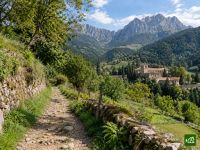
The Camino Lebaniego is the pilgrim way from the fishing port of San Vicente de la Barquera to the monastery of Santo Toribio de Liébana, which guards what is said to be the largest surviving piece of the True Cross. It leaves the Camino del Norte to follow the Nansa river inland, crosses hills of oak and beech wood to the pre-Romanesque church of Santa María de Lebeña and ends in the Liébana valley, beneath the Picos de Europa.
Camino Lebaniego map
The interactive map shows the whole route, with accommodation, water and public transport along the way.
Camino Lebaniego route planner
Build a day-by-day itinerary in the route planner, find accommodations along the route, and download the GPX file. Start from an example below or from scratch.
4-Day ItineraryShown below
The Camino Lebaniego in four days, from the church of Santa María de los Ángeles in the fishing port of San Vicente de la Barquera to the monastery of Santo Toribio de Liébana and its relic of the True Cross. The first day leaves the coast through Serdio and Muñorrodero, where the route parts from the Camino del Norte, and follows the riverside path of the Nansa to Camijanes. The second passes Cabanzón and Cades and climbs to the albergue at Lafuente. The third crosses the Collado de Hoz to Cicera, then goes down through oak and beech woods to Lebeña and its pre-Romanesque church of Santa María. The last climbs to Cabañes and goes by Pendes, Tama and the old town of Potes up to the monastery.
Camino Lebaniego stages
4 days, 68 km and 2,443 m of ascent. These stages follow the 4-Day Itinerary. Open it in the route planner to split or merge days and choose where you sleep.
- Stage 121.7 km↑ 477 m · ↓ 431 m ·
7–8h with stopsTo Camijanes
Night at Casas Rurales Primorías - Camijanes - Stage 215.7 km↑ 476 m · ↓ 197 m ·
5–6h with stopsCamijanes Lafuente
Night at Albergue Los Pumares - Stage 314.3 km↑ 727 m · ↓ 882 m ·
5–6h with stopsLafuente Lebeña
Night at Casa rural El Agero - Stage 416.7 km↑ 763 m · ↓ 476 m ·
6–7h with stopsLebeña Santo Toribio de Liébana
Best time to go
- Best time1 May – 30 Sept
- Good time20 Mar – 30 Apr, 1 Oct – 31 Oct
- Possible, with care1 Nov – 19 Mar
May to September is the best time, with long daylight and the albergues along the way open; July and August are the busiest months, so book ahead. Late March, April and October are good but cooler and wetter. From November to the 20th of March the albergue at Puente El Arrudo, where the first stage ends, is shut, so that night needs another bed, daylight runs short for the long stages and the hills between Lafuente and Lebeña can get snow.
Frequently asked questions
How long is the Camino Lebaniego, and should you walk it in three, four or five stages?
Three, four or five days all work, and four is the most comfortable split. The Fundación Camino Lebaniego divides the route into three official stages, from San Vicente de la Barquera to Cades, on to Cabañes and up to Santo Toribio, though it says itself that this is only one way of dividing it. The middle stage is the problem. It is the longest of the three and carries most of the climbing, over the Collado de Hoz to Cicera and on through oak and beech woods to Lebeña, so breaking it at Cicera gives the four-day plan that pilgrim guides commonly suggest. That plan still opens with the whole first stage to Cades, which becomes the longest day of the four. For days of more even length, stop a little before each of those stage villages instead: at Camijanes, at the Los Pumares albergue in Lafuente, and at Lebeña, which has casas rurales. For five days, keep the Cicera break and shorten the first stage as well, with a night in Serdio or Camijanes, where the official stage guide lists other lodging. Do not plan the days off the published stage figures alone, since they run a little longer than what the trail measures on the ground. The Traileasy planner lays the route out night by night, so a three-day and a five-day plan can be set side by side before you book a single bed.
Is the Camino Lebaniego difficult?
It is a moderate walk with one hard day. Nothing on it is technical: the route follows riverside paths, farm tracks and quiet roads, waymarked with red arrows and the cross of Santo Toribio. The difficulty sits in the official second stage. It leaves the Nansa valley, climbs over the Collado de Hoz to Cicera, crosses another col through oak and beech woods, drops to Lebeña and pulls up again to Cabañes, so unless you split it, most of the route's climbing falls on one long day. Expect plenty of asphalt too. The road from Cades towards Lafuente has no shoulder, and the Fundación has put up "atención peregrinos" signs along it, so walk facing the traffic. Some training helps, and the Fundación's own advice is to build up your walking time week by week before you start.
Is the Camino Lebaniego part of the Camino de Santiago?
No, though the two are closely tied. Its goal is the Monasterio de Santo Toribio de Liébana, where pilgrims come for the Lignum Crucis, venerated as the largest surviving piece of the True Cross, and the route has its own credencial and its own certificate. For its first stretch it is the Camino del Norte: from San Vicente de la Barquera both share the way as far as Muñorrodero, where the yellow arrows carry on towards Santiago and the red ones turn inland. Since 2015 it has been on the UNESCO World Heritage list together with the Caminos del Norte. Many pilgrims link the two, either by taking the bus from Potes back to Unquera to rejoin the Camino del Norte, or by carrying on from Liébana along the Camino Vadiniense, which crosses the Picos de Europa to meet the Camino Francés at Mansilla de las Mulas. The Camino Lebaniego Castellano from Palencia and the route from León are other ways to Santo Toribio, separate from this one.
Do you need a credencial, and how do you get the Lebannensis at Santo Toribio?
Yes, and it has to be the new one. Since 19 May 2026 the official credencial is issued jointly by the Gobierno de Cantabria, through the Fundación Camino Lebaniego, and the Obispado de Santander. Older credentials have been officially retired, although one already in use with earlier stamps is still accepted. The new one is available at the pilgrim office in Santander cathedral, at the church of Nuestra Señora de los Ángeles in San Vicente de la Barquera, at the Centro de Estudios Lebaniegos in Potes and at the monastery itself. Get it stamped as you go, because the public albergue in Potes only takes pilgrims whose credencial carries at least one stamp from each stage. At Santo Toribio the Franciscan community adds the final stamp and a dry seal, and the monastery issues the Lebannensis, the new pilgrim certificate, in Spanish or Latin and signed by its guardian. The older Lebaniega is still sold for a token price, but only as a certificate of visit. All of this changed in 2026, so check the Fundación's credentials page before setting off.
When is the next Año Jubilar Lebaniego?
The next one falls in 2028. A Año Jubilar Lebaniego is held in every year in which 16 April, the feast of Santo Toribio, falls on a Sunday, which happens in 2028 and then again in 2034. The last jubilee ran across 2023 and 2024. During a jubilee the monastery opens its Puerta del Perdón, and pilgrims can gain the jubilee indulgence by meeting the conditions set by the Church. A jubilee is not needed to walk the route or to receive the Lebannensis, since the pilgrimage to Santo Toribio can be made in any year. When last checked, at the start of October 2026, the Fundación had not yet published dates or a programme for 2028, so confirm the details on its official site nearer the time.
Where do you sleep on the Camino Lebaniego, and do you need to book the albergues?
In a short chain of pilgrim albergues, several of which need booking. At the end of the first stage, El Cárabo in Puente El Arrudo takes reservations only through its own website and opens from late March to the end of October, and the hostel in San Vicente de la Barquera keeps the same season. Los Pumares in Lafuente, a short way off the official route, is open all year. Cicera's albergue must be booked ahead and has few services, with meals at the village bar, which is not always open. Cabañes has a private albergue with its own bar and restaurant and a small donation-based public one, La Casuca del Perdón, and both recommend booking. Potes has a large public albergue, also donation-based, where you register first at the pilgrim office in the Centro de Estudios Lebaniegos, stay one night only and show a stamped credencial. Opening periods and rules change from year to year. Check each one before you go.
Does the Camino Lebaniego follow the Senda Fluvial del Nansa?
Partly. From Muñorrodero, where it leaves the Camino del Norte, the main route follows the first section of the Senda Fluvial del Nansa as far as Camijanes, a shaded path through riverside woodland with wooden walkways, fishermen's huts and the Mirador del Poeta along the way. The second section, from La Vega near Camijanes on to Cades, is not the official line. The Fundación Camino Lebaniego offers it as a natural alternative to the road through Cabanzón, but only in summer when the Nansa is low, and warns that it will be muddy. In wet weather or out of season, stay on the official road route. In the Traileasy planner that second section is a variant you can add to the first stage, and the day's distance and climb update straight away.
How do you get back from Potes to San Vicente de la Barquera or Santander?
By the Autobuses Palomera coach, now run with Jiménez Movilidad, from Potes bus station to Santander, calling at Panes, Unquera, San Vicente de la Barquera, Cabezón de la Sal and Torrelavega on the way. The ride to San Vicente takes about an hour, which suits anyone who left a car at the start. On weekdays there are early-morning, mid-morning and afternoon departures all year. On the timetable in force from 8 September 2026, Saturdays, Sundays and holidays have two, one in the morning and one in the early evening. From 13 October 2026 until Easter 2027 the morning bus does not run on Sundays and holidays, so on those days only the evening one leaves. Unquera is the stop for rejoining the Camino del Norte towards Asturias, and it also has trains. Groups of more than six should let the company know two days ahead. From Santo Toribio back down to Potes is a short walk or a taxi ride, and Potes has a taxi rank. Timetables change with the seasons, so check the current one on the Jiménez Movilidad website, under its Cantabria lines, before planning the last day.