
Camino de Santiago (Camino Primitivo)
Also known as Original Way
About Camino de Santiago (Camino Primitivo)
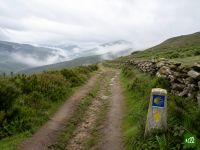
The oldest way to Santiago, the route King Alfonso II took from Oviedo in the ninth century. It climbs over the Asturian hills on high, remote stages before dropping into Galicia to join the Camino Francés at Melide, and it is the most mountainous of the main pilgrim routes.
Camino de Santiago (Camino Primitivo) map
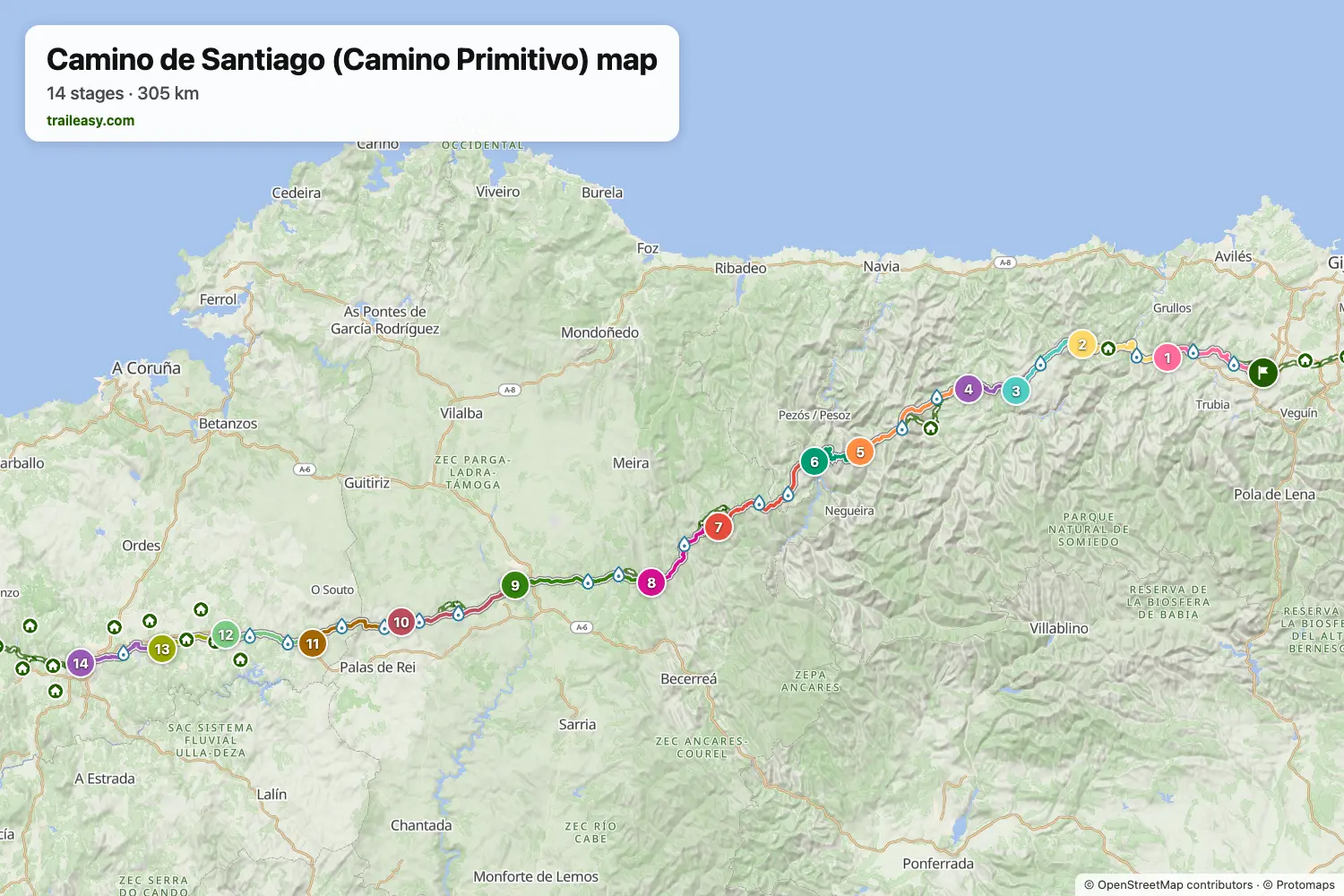
The interactive map shows the whole route, with accommodation, water and public transport along the way.
Camino de Santiago (Camino Primitivo) route planner
Build a day-by-day itinerary in the route planner, find accommodations along the route, and download the GPX file. Start from an example below or from scratch.
14-Day ItineraryShown below
The original pilgrim road to Santiago, walked end to end from the cathedral of San Salvador in Oviedo to the Praza do Obradoiro. It climbs out of the Asturian valleys through Grado, Salas and Tineo, crosses the high moorland above Berducedo and drops to the reservoir at Grandas de Salime, then works west into Galicia past A Fonsagrada and the Roman walls of Lugo before joining the Camino Francés at Melide for the final stretch through eucalyptus country. A short day into Campiello keeps the big mountain crossing fresh, and Lugo makes a natural halfway pause.
Camino de Santiago (Camino Primitivo) stages
14 days, 312 km and 8,562 m of ascent. These stages follow the 14-Day Itinerary. Open it in the route planner to split or merge days and choose where you sleep.
- Stage 125.4 km↑ 537 m · ↓ 696 m ·
8–9h with stopsOviedo Grado
Night at Albergue La Quintana - Stage 222.6 km↑ 740 m · ↓ 560 m ·
7–8h with stopsGrado Salas
Night at Casa Sueño - Stage 319.7 km↑ 760 m · ↓ 373 m ·
6–7h with stopsSalas Tineo
Night at Palacio de Meras Hotel y Restaurante - Stage 413.1 km↑ 388 m · ↓ 425 m ·
4–5h with stopsTineo Campiello
Night at Casa Herminia - Stage 527.9 km↑ 1,089 m · ↓ 779 m ·
10–11h with stopsCampiello Berducedo
Night at Casa de Aldea Araceli - Stage 619.7 km↑ 670 m · ↓ 1,029 m ·
7–8h with stopsBerducedo Grandas de Salime
Night at Fonda Arreigada - Stage 731.0 km↑ 993 m · ↓ 668 m ·
10–11h with stopsGrandas de Salime A Fonsagrada
Night at Complejo O Piñeiral - Stage 821.6 km↑ 738 m · ↓ 902 m ·
7–8h with stopsA Fonsagrada O Cádavo Baleira
Night at Albergue Porta Santa en Cádavo Baleira - Stage 929.8 km↑ 574 m · ↓ 828 m ·
9–10h with stopsO Cádavo Baleira Lugo
Night at Mendez Nuñez - Stage 1026.4 km↑ 627 m · ↓ 545 m ·
8–9h with stopsLugo Ferreira
Night at Albergue A Nave de Ferreira- camino primitivo Lugo - Stage 1120.9 km↑ 424 m · ↓ 515 m ·
6–7h with stopsFerreira Melide
Night at Albergue San Antón - Stage 1219.1 km↑ 456 m · ↓ 512 m ·
6–7h with stopsMelide Arzúa
Night at Taberna Vella, Albergue - Heidi´s place - Stage 1314.8 km↑ 214 m · ↓ 333 m ·
4–5h with stopsArzúa O Pedrouzo
Night at Albergue O Trisquel - Stage 1419.8 km↑ 352 m · ↓ 379 m ·
6–7h with stopsO Pedrouzo Santiago de Compostela
Best time to go
- Best time1 May – 30 Jun, 1 Sept – 30 Sept
- Good time1 Apr – 30 Apr, 1 Jul – 31 Aug, 1 Oct – 31 Oct
- Possible, with care1 Nov – 31 Mar
May, June and September are the best months, when the mountain albergues are open and the high line is clear. The hard stages sit in the Cantabrian range rather than by the sea, so they run colder and cloudier than the rest of northern Spain. From November to March the small mountain albergues close and snow lingers around the Puerto del Palo.
Frequently asked questions
Should you take the Hospitales route or go by Pola de Allande?
Take Hospitales only on a clear forecast, and drop to Pola de Allande in fog, rain or snow. The high line leaves the waymarks at Borres and runs for hours along an open ridge past the ruins of three medieval pilgrim hospitals before topping out at the Puerto del Palo, and there is no bar, shop or tap anywhere on it. In cloud that ridge turns into a navigation problem rather than a viewpoint, since the markers are posts and cairns in rough grass and Asturian mist can sit on the tops for a whole morning. The Pola de Allande line drops into the valley instead, gives you a town with albergues, a shop and bars, then makes its own steep pull to the same pass, so the total is longer and the climb sharper, though it is sheltered, served, and easily broken into two shorter days. Settle it the evening before rather than at breakfast, because beds around Borres are few and the two lines need different overnight stops. In Traileasy the Pola de Allande alternative sits alongside the default high line as a variant you can switch on, and the drinking water points are mapped village by village, which is worth a look before the one day that has none.
How hard is the Camino Primitivo compared with the other caminos?
Of the main pilgrim routes to Santiago this is the toughest, though what makes it hard is cumulative rather than technical. Nothing on it asks for a head for heights or a hand on rock, but the Asturian half climbs and drops all day, and a stage can swallow six or seven hours while covering less ground than an easy day on the inland route. Two days do most of the damage: the crossing to Berducedo over the Puerto del Palo, and the plunge off the ridge to the Salime reservoir, which loses in one afternoon almost everything you spent the morning gaining and is followed by a long haul back up towards A Fonsagrada. Underfoot it is mostly earth track, forest path and quiet lane, so knees suffer from gradient here rather than from asphalt. Galicia comes as relief, since the second half rolls through farmland and the profile finally flattens. Regular walkers with a few consecutive long days behind them cope well, but this is a poor choice for a first multi day walk.
How many days does the Camino Primitivo take?
Twelve walking days is the standard split from Oviedo to Santiago, and around a fortnight covers it once travel at both ends is counted. That is this route's real advantage for anyone who cannot free up a month or more, since it gives you a whole camino, cathedral to cathedral, inside an ordinary holiday. Strong walkers squeeze it into ten, though the mountain stages punish that harder than the daily figures suggest, and a rest day in Lugo inside the Roman walls is a better use of a spare day than a fast finish. Starting at Lugo instead covers the final qualifying stretch into Santiago in about five days and still earns the Compostela, with none of the crush that comes from starting at Sarria. Anyone arriving off the Camino del Norte joins at Villaviciosa and spends two extra days crossing the hills to Oviedo before the Primitivo proper begins.
What time of year is best for the Camino Primitivo?
Between June and September, with early June and the tail of September the pick if you want the mountains clear and the albergues calm. The hard stages sit in the Cantabrian range rather than beside the sea, so they run colder and cloudier than the rest of northern Spain, and snow can linger around the Puerto del Palo long after spring has arrived in Oviedo. Wet days turn up in any month on this coast, which is why the Hospitales crossing is a call made on the morning forecast instead of a fixture in the plan. October still suits the Galician half but brings the rain back in earnest, and from November to March the small mountain albergues close, daylight runs short and the high line is best left alone. Opening dates move around at the tiny places, so confirm them for your own dates rather than working from last season's stage list.
Should you reserve albergues ahead on the Camino Primitivo?
In July and August yes, and through the rest of the season a call a day or two ahead saves the mountain half from becoming a race. The pinch is supply rather than crowds, because several villages where a stage naturally ends run a single albergue with a dozen or two beds, and the sums fail fast when a whole day's walkers aim at the same roof. Berducedo is the classic squeeze, being the first bed after the pass and the point where the Hospitales and Pola lines empty into one another, and its municipal beds are handed out on the day rather than held for anyone. Borres before the high crossing, La Mesa, Grandas de Salime and A Fonsagrada are the others worth pinning down early. In May, June and late September you can usually walk in and find something if you arrive by mid afternoon, though it pays to carry the number of the next village along. Private albergues and pensions here take reservations by phone or WhatsApp, which is simply how these mountain villages do business.
What changes when the Camino Primitivo joins the Camino Francés at Melide?
The atmosphere changes completely, and it happens with only two or three days left to walk. The Primitivo meets the Francés at Melide, and after a week and a half of near empty tracks you step into a steady stream of pilgrims heading for the same cathedral. Bars, shops and albergues appear constantly from there on, which is a comfort after the mountains and a jolt at the same time, and beds in Arzúa and O Pedrouzo now have to be shared with everyone who set off from Sarria. Fix those last nights in high season, or end your stages at one of the small places between the towns and let the traffic go past. Melide earns its stop anyway for pulpo a feira, which the town does better than anywhere else on the way. Traileasy also carries the continuation to Finisterre as an alternative finish, so a plan that feels too crowded at the end can keep walking through Santiago to the coast.
Where does the Camino Primitivo begin, and how do you reach Oviedo?
It starts at the Cathedral of San Salvador in Oviedo, from where Alfonso II rode out in the ninth century on what became the first pilgrimage to Santiago. Inside it the Cámara Santa keeps the Arca Santa and the relics that once made Oviedo a destination in its own right, which is the sense behind the old warning that whoever visits Santiago and not the Salvador has called on the servant and not the Master, so leave yourself an afternoon in the city before the first stage. Credentials cost a couple of euros at the cathedral, the tourist office or the municipal albergue, and you want one from the first night for the albergues and for the certificate at the far end. Reaching Oviedo is straightforward, with Asturias airport a short bus ride up the coast, high speed trains and Alsa coaches running north from Madrid, and buses along the coast from Santander and Bilbao. Pilgrims switching over from the Camino del Norte follow the waymarked link out of Villaviciosa, which takes two days across the hills into the city. Flights home go from Santiago at the other end, so the trip is one way at both ends rather than a loop back to the start.