
Camino de Santiago (Camino Portugués)
Also known as Portuguese Way or Caminho Português
About Camino de Santiago (Camino Portugués)
The pilgrim way north from Lisbon through Portugal to Santiago de Compostela, past Roman roads, medieval bridges and the cathedral cities of Coimbra and Porto. Beyond Porto walkers choose between the inland Central route and the Coastal way along the Atlantic, both crossing into Galicia at the Minho.
Camino de Santiago (Camino Portugués) map
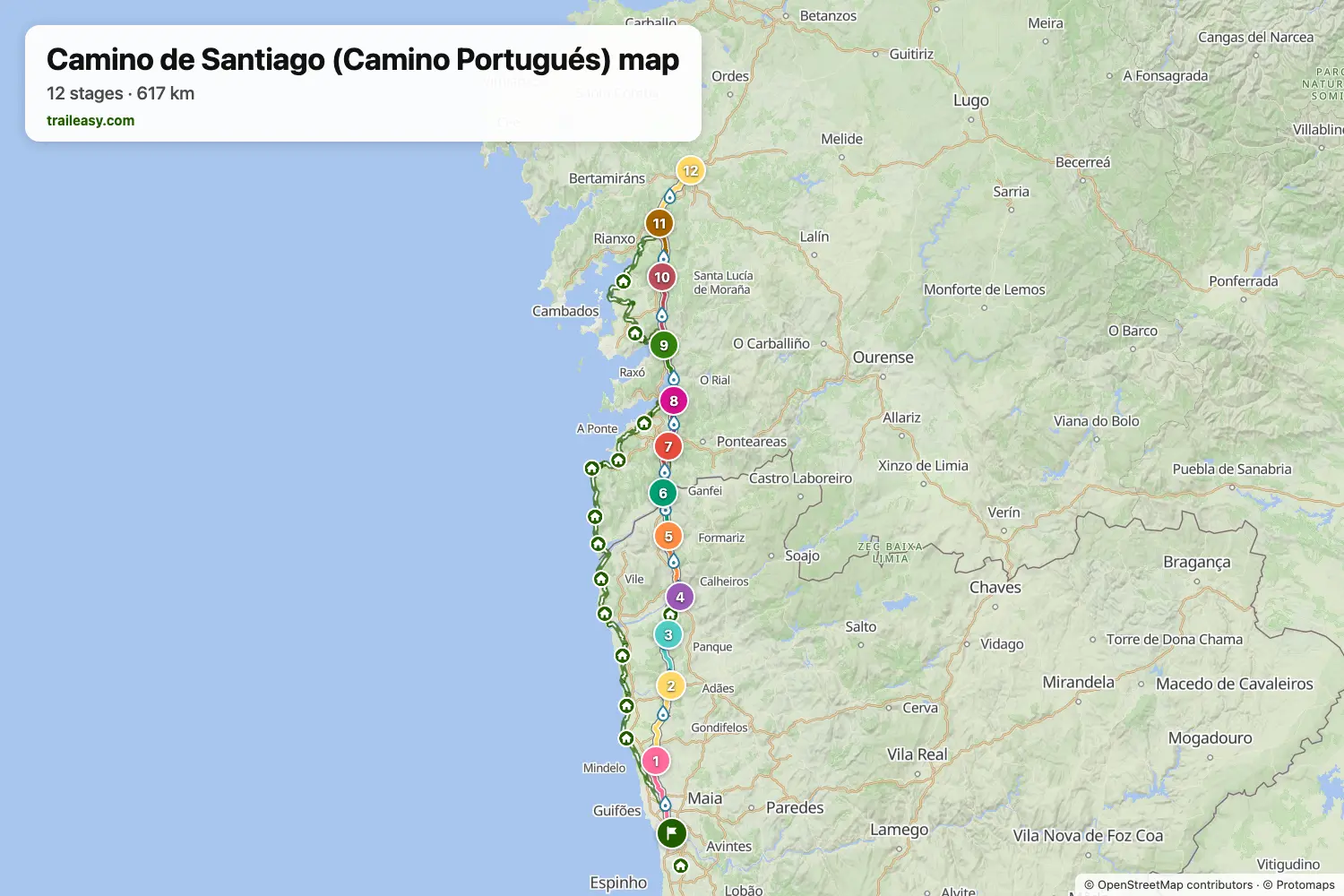
The interactive map shows the whole route, with accommodation, water and public transport along the way.
Camino de Santiago (Camino Portugués) route planner
Build a day-by-day itinerary in the route planner, find accommodations along the route, and download the GPX file. Start from an example below or from scratch.
12-Day ItineraryShown below
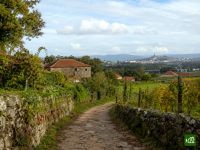
The most-walked stretch of the Camino Portugués, north from Porto's riverside to the Praza do Obradoiro in Santiago on the inland Central route. It leaves the Douro for the cobbled lanes and vine-covered quintas of the Minho — the medieval bridge and rooster legend at Barcelos, the riverside arcades of Ponte de Lima, and the climb over the Labruja ridge to Rubiães. The river crossing at Valença puts you into Galicia at the cathedral town of Tui, and from there the way runs on through the oyster inlets at Redondela, the old quarter of Pontevedra and the hot springs of Caldas de Reis before the last eucalyptus woods from Padrón carry you into Santiago.
Camino de Santiago (Camino Portugués) stages
12 days, 253 km and 4,209 m of ascent. These stages follow the 12-Day Itinerary. Open it in the route planner to split or merge days and choose where you sleep.
- Stage 125.4 km↑ 372 m · ↓ 314 m ·
7–8h with stopsPorto Vairão
A long day out of the city on cobbles and pavement, with the suburbs giving way to farmland only in the last hours.
Night at Albergue de Peregrinos do Mosteiro de Vairão - Stage 230.9 km↑ 470 m · ↓ 493 m ·
9–10h with stopsVairão Barcelos
The longest day, easy underfoot but relentless, through vineyards, eucalyptus and a string of small villages.
Night at Hotel Restaurante Bagoeira - Stage 319.8 km↑ 346 m · ↓ 280 m ·
6–7h with stopsBarcelos Vitorino dos Piães
Quiet lanes and farm tracks, rolling gently, past granite hamlets and vine trellises the whole way.
Night at Albergue De Peregrinos Casa Da Fernanda - Stage 413.7 km↑ 157 m · ↓ 255 m ·
4–5h with stopsVitorino dos Piães Ponte de Lima
A short downhill morning that ends on a long medieval bridge over a wide, slow river.
Night at Hotel Império do Norte - Stage 522.0 km↑ 644 m · ↓ 403 m ·
7–8h with stopsPonte de Lima Rubiães
The one real climb of the Portuguese route, steep up to a wooded pass and rough going down the far side.
Night at Casa da Capela - Stage 614.9 km↑ 161 m · ↓ 391 m ·
4–5h with stopsRubiães Tui
Downhill all morning to the border river, crossed on a high iron bridge into Spain.
Night at Parador de Tui - Stage 723.1 km↑ 290 m · ↓ 283 m ·
7–8h with stopsTui O Porriño
Flat and easy, though the standard line runs past an industrial estate that the riverside variant avoids.
Night at Alojamiento Camino Portugues - Stage 816.2 km↑ 291 m · ↓ 307 m ·
5–6h with stopsO Porriño Redondela
A gentler day with one wooded climb, ending with the first sight of the sea inlets.
Night at Albergue A Casa da Herba, Redondela - Stage 919.2 km↑ 448 m · ↓ 442 m ·
6–7h with stopsRedondela Pontevedra
Rolling coastal country, in and out of small valleys on old stone paths and quiet road.
Night at Galicia Palace - Stage 1022.6 km↑ 257 m · ↓ 256 m ·
6–7h with stopsPontevedra Caldas de Reis
Easy forest track and riverside path, with the crowds thickening as the routes converge.
Night at Hotel "O Cruceiro" - Stage 1119.5 km↑ 266 m · ↓ 279 m ·
6–7h with stopsCaldas de Reis Padrón
Another straightforward day through eucalyptus woods, following the river down to town.
Night at Pensión Restaurante Bar Grilo - Stage 1225.7 km↑ 507 m · ↓ 261 m ·
8–9h with stopsPadrón Santiago de Compostela
A last climb through the suburbs to the cathedral, the final hour all on pavement.
Best time to go
- Best time1 Apr – 30 Jun, 1 Sept – 31 Oct
- Good time1 Mar – 31 Mar, 1 Jul – 31 Aug, 1 Nov – 30 Nov
- Possible, with care1 Dec – 29 Feb
April to June and then September and October are the best months, with a warm sea in autumn and the harvest under way in the Minho. The inland stages between Porto and the border are farmland and cobble with very little shade, and an afternoon on hot granite in July drains people fast. From December to February nothing is closed by snow, but daylight is short, many private albergues shut and the seasonal ferries run reduced or not at all.
Frequently asked questions
Should you walk the Central or the Coastal route from Porto?
Take the Central if you came for the old pilgrim road, and the Coastal if you would rather have the Atlantic beside you for a week. The two part at the cathedral in Porto and do not meet again until Redondela, so this is a genuine fork rather than a detour. The Central line runs inland through Barcelos, Ponte de Lima and Rubiães on Roman causeways and medieval bridges, and it carries the one proper climb of the route, over the Labruja hills to the Alto da Portela Grande before the border. The Coastal line goes north through Vila do Conde, Esposende and Viana do Castelo on boardwalks and seafront promenades, is flatter and a little longer, and crosses into Spain by the small ferry at Caminha instead of the bridge at Valença. Beds differ as much as the scenery, since the coast puts you in beach towns that are lovely in June and pricey in August, while the inland villages stay cheap and quiet all summer. Connections inland from Póvoa de Varzim to Rates and from Esposende to Barcelos mean you can start on one and change your mind. If you want to weigh them up before committing, Traileasy carries the Coastal Camino as a route in its own right beside the Central line, rejoining it at Redondela.
Should you start the Camino Portugués in Lisbon or Porto?
Start in Porto unless you specifically want the long Portuguese approach and have a month to give it. The full route from Lisbon is broken into roughly twenty five stages through Santarém, Tomar and Coimbra, and it is a hot, quiet, road-heavy walk where whole days pass without meeting another pilgrim. Facilities are the real obstacle, since albergues south of Coimbra are sparse and often need a phone call, bag transfer barely exists, and the waymarking wants more attention than it does in the north. Porto removes all of that at once: an international airport, Santiago inside a two week holiday, and a route that suddenly has company, cafes and beds at sensible intervals. Coimbra is the honest middle option for anyone with three weeks, keeping the Templar convent at Tomar within reach as a side trip while still finishing at the cathedral. Walking the Lisbon half is a fine thing to do, just do it knowing it is a different and lonelier trip from the one people describe when they talk about this camino.
How long does it take to walk the Camino Portugués?
About a fortnight from Porto, or about a month if you start in Lisbon and walk the whole thing. The full route splits into roughly twenty five guidebook stages, and on the popular half from Porto most walkers reach Santiago in ten to twelve days on the Central line, or a day or two more on the Coastal one. From Tui, the shortest common start, it is six or seven days. Allow an extra day for the Spiritual Variant, which loops out through Armenteira before rejoining near Padrón, and another if you want a morning in Porto or an afternoon in Ponte de Lima rather than a march. Walking days here are gentler than on the mountain caminos, five to seven hours on largely level ground, so your calendar is decided by how many stages you take rather than by how hard any single one is.
How difficult is the Camino Portugués?
It is the gentlest of the main caminos underneath and the hardest on your feet. There is no mountain day at all: the profile stays low, the only sustained climb on the Central line is over the Labruja hills before Rubiães, and the Coastal line barely rises above the sea. The wear comes from the surface, because something close to a third of the Portuguese stages runs on calçada, the granite cobble paving that photographs beautifully and punishes your soles after six hours on it. Wet cobbles turn slick, so poles earn their keep on the descents, and a cushioned thick sole does more for you on this route than stiff ankle support. This is also a more built up camino than the inland routes, with industrial suburbs on the way out of Porto and a long urban approach through Vigo on the Coastal line, so pavement is part of the deal. In fitness terms anyone able to walk consecutive days on flat ground will cope, which is why so many people choose it as a first pilgrimage.
Should you start in Tui to earn the Compostela?
Tui is the standard choice, as the first town on this route far enough out to clear the final hundred kilometres on foot that the Compostela requires, with a margin to spare. Six or seven days is the usual pace from there, through O Porriño, Redondela, Pontevedra and Caldas de Reis, and over that stretch you need two stamps in your credential for every day rather than one. Most walkers sleep the night before in Valença, the Portuguese fortress town on the far bank, then cross the Minho next morning on the walkway of the international bridge. There is no checkpoint and nobody looks at a passport, but the clock jumps an hour forward into Spanish time as you cross, which ambushes anyone who set an alarm the night before, and phones sometimes flip between the two zones halfway over. The euro carries on, though the language shifts to Galician and Spanish, meals move later in the evening, and the bars stop selling pastéis de nata. Be aware that this final stretch in July and August is the busiest part of the whole camino, so it needs beds arranged in a way the Portuguese section does not.
What is the Spiritual Variant, and should you take the Traslatio boat?
The Spiritual Variant is a three day loop off the main line at Pontevedra, and the boat across the estuary is its traditional last leg. It runs out to the coast through Poio and Combarro, climbs to the monastery at Armenteira, then drops down the Ruta da Pedra e da Auga, a path along an old mill stream, to the water at Vilanova de Arousa. From there the Traslatio follows the sea journey that legend gives to the body of Saint James, up the Ría de Arousa and the river Ulla to Pontecesures, passing the stone crosses that make it the only maritime Way of the Cross anywhere. Small operators run the crossing for around thirty euros in roughly an hour and a half, sailing times move with the tide, and departures thin out or stop outside the walking season, so book a day or two ahead and confirm the hour rather than turning up at the pier. Taking the boat costs you nothing if you started in Tui, since the walking either side of it already clears the qualifying distance, and anyone who wants a purely walking pilgrimage can follow the shore to Pontecesures instead in one long day. The Spiritual Variant is stored in Traileasy as its walking line rather than the boat leg, so the plan counts the days you spend on foot and the Traslatio stays something you book with the operator.
Do you need to book accommodation on the Camino Portugués in advance?
Book from Porto onwards in high summer, and lean on it far less in the Portuguese countryside further south. Albergues in Portugal are mostly small private houses that accept a reservation by phone or message, so a bed really can be held for you, and pensions are cheap enough that a private room now and then is no great extravagance. The pinch is in Galicia, where the Xunta hostels give out beds in the order people walk through the door and hold nothing back for bookings, and where everyone who began in Tui wants the same bunk in Redondela, Pontevedra or Caldas de Reis on the same night. Coastal stages bring a second problem in July and August, since Viana do Castelo, Baiona and the resorts north of Porto fill with holidaymakers who are not pilgrims at all and prices rise to match. A sensible pattern is to fix Porto, the night at the border and the Galician stages, and leave the quiet middle of Portugal open. South of Coimbra the logic reverses again, because the handful of places that exist may want a call the day before, opening only when they know someone is coming.
What is the best time of year to walk the Camino Portugués?
May, June or September. On this Camino the month and the route choice are the same decision, which is what makes it different from the others. Summer pushes you towards the coast for the sea breeze, then charges you for it with the nortada, the north wind that blows into your face the whole way up to Galicia. Winter pushes you inland instead, since the seasonal ferries that stitch the coastal route together run reduced or not at all. September is the month people come back for, with a warm sea and the harvest under way in the Minho. One date to check before you fix a year: 2027 is the next Holy Year, and every route fills when the cathedral opens its Holy Door.