
Camino de Santiago (Camino Inglés)
Also known as English Way
About Camino de Santiago (Camino Inglés)
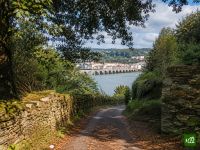
The way that pilgrims sailing from northern Europe walked once they came ashore in Galicia, leading from the naval harbour of Ferrol inland to Santiago de Compostela. It traces the estuary shore, then climbs through eucalyptus woods, hamlets and stone granaries on a quieter, greener path than the busier Caminos.
Camino de Santiago (Camino Inglés) map
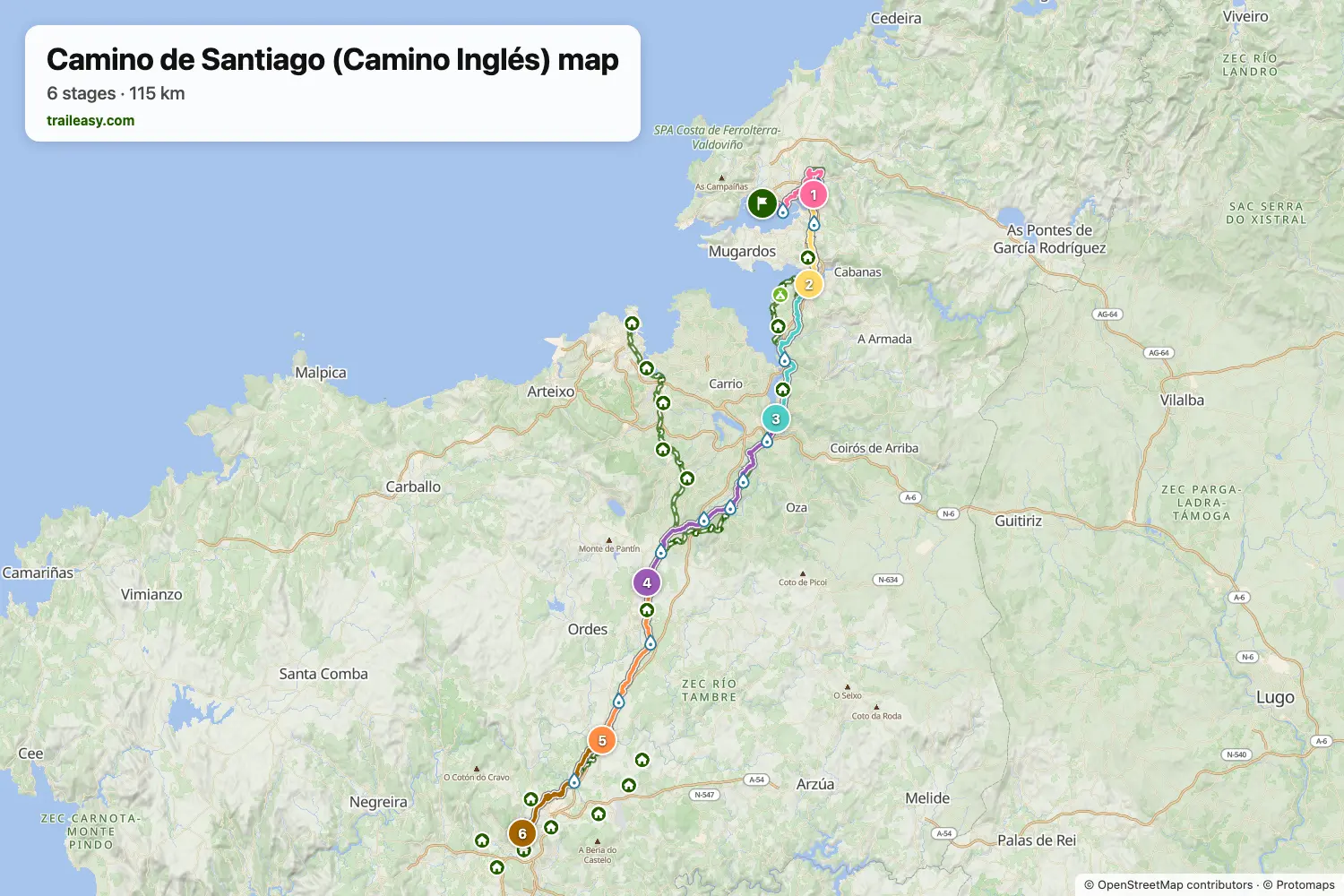
The interactive map shows the whole route, with accommodation, water and public transport along the way.
Camino de Santiago (Camino Inglés) route planner
Build a day-by-day itinerary in the route planner, find accommodations along the route, and download the GPX file. Start from an example below or from scratch.
6-Day ItineraryShown below
The classic Camino Inglés from the naval harbour of Ferrol to the cathedral square in Santiago de Compostela, following the medieval pilgrim road once used by sailors from England and Ireland. The way rounds the sheltered rías of Ferrol and Ares, crosses the Eume at Pontedeume's long bridge and the Mandeo at the old town of Betanzos, then climbs into quiet Galician farmland over Hospital de Bruma before the final approach through eucalyptus woods into Santiago. Hearty Galician cooking, historic albergues and far fewer pilgrims than the Camino Francés.
Camino de Santiago (Camino Inglés) stages
6 days, 120 km and 2,560 m of ascent. These stages follow the 6-Day Itinerary. Open it in the route planner to split or merge days and choose where you sleep.
- Stage 117.5 km↑ 212 m · ↓ 218 m ·
5–6h with stopsTo Neda
Night at Pazo da Mercé - Stage 211.8 km↑ 267 m · ↓ 269 m ·
3–4h with stopsNeda Pontedeume
Night at Hotel Eumesa - Stage 320.5 km↑ 605 m · ↓ 601 m ·
7–8h with stopsPontedeume Betanzos
Night at Hotel Garelos - Stage 428.7 km↑ 808 m · ↓ 464 m ·
9–10h with stopsBetanzos O Castro
Night at A casa de Ardemil - Stage 520.6 km↑ 235 m · ↓ 357 m ·
6–7h with stopsO Castro Sigüeiro
Night at Albergue Segue o Camiño - Stage 621.5 km↑ 433 m · ↓ 411 m ·
7–8h with stopsSigüeiro Santiago de Compostela
Best time to go
- Best time1 Apr – 30 Jun, 1 Sept – 31 Oct
- Good time1 Mar – 31 Mar, 1 Jul – 31 Aug, 1 Nov – 30 Nov
- Possible, with care1 Dec – 29 Feb
April to June and then September and October are the best months, with settled weather and comfortable walking temperatures. July and August are warmest and busiest, though the route stays far quieter than the Camino Frances even at peak. From December to February walking is feasible since there is no snow at these heights, but the days are short, the rain is persistent and some private albergues close.
Frequently asked questions
Should you start the Camino Inglés in Ferrol or A Coruña?
Start in Ferrol if you want the Compostela on the strength of this walk alone, since the A Coruña branch falls short of the 100 km the Pilgrim Office requires. Ferrol is the historic naval port and the longer of the two approaches, taking most walkers five or six days by way of Pontedeume and Betanzos. A Coruña is the older landing place and makes a shorter three or four day walk, and the two branches meet at Hospital de Bruma before the final run into Santiago. Choose A Coruña if you are short on time, already have a qualifying walk behind you, or simply want the coastal city as your starting point. Ferrol is the more popular choice, though busy on this route still means a fraction of the traffic on the Camino Francés.
How many days does it take to walk the Camino Inglés?
Most people walk it from Ferrol in five or six days, with daily stages of roughly four to seven hours. The usual split runs Ferrol to Pontedeume, on to Betanzos, then the long climb to Hospital de Bruma, then Sigüeiro, and finally Santiago. The Betanzos to Bruma day is the one that stretches people, since it carries the most climbing and has almost nothing in the way of services in between. Six days gives you a gentler version by breaking the opening stage at Neda or Miño. From A Coruña the walk takes three or four days before joining the Ferrol branch at Bruma.
Does the Camino Inglés qualify for the Compostela, and what is the Celtic Camino?
Yes from Ferrol, and only conditionally from A Coruña. The Ferrol start clears the 100 km minimum the Pilgrim Office sets for a walking Compostela, so a continuous walk from there earns the certificate provided you collect two stamps a day over the final stretch. The A Coruña branch covers about 75 km and falls short on its own, which is where the Celtic Camino comes in, since the Cathedral authorities accept it once you have walked a certified 25 km on a recognised pilgrim route in Ireland or Britain to make up the difference. In Ireland, Camino Society Ireland verifies that walk and issues a Celtic Camino Compostela, which you then present in Santiago alongside your Camino Inglés stamps. Carry a pilgrim passport from the first day either way, because the certificate rests on the stamps rather than on anything registered at the start.
When is the best time to walk the Camino Inglés?
May, June and September are the pick, though on a route this short the month matters less than you would expect. Galicia is green because it rains. It does so in every one of those months. What a short Camino cannot do is absorb a bad week: on a five week route you walk through a wet spell, on this one it can be most of your walk, so the forecast a few days out is worth more than the seasonal average. The eucalyptus tracks hold mud for days after a downpour and that is the part people remember. Numbers climb sharply around the feast of Saint James in late July and in a Holy Year, which is the one time the route feels busy.
How hard is the Camino Inglés?
It is a moderate walk with no serious mountain terrain, well within reach of anyone comfortable with several consecutive days on their feet. The route rolls constantly rather than climbing anything high, and the stiffest section is the long pull from Betanzos up to Hospital de Bruma. The common complaint is surface rather than gradient, since a good share of the way runs on asphalt and concrete lanes, and the stretch out of Ferrol through Narón and Neda is suburban rather than rural. Broken in footwear matters more here than on rougher trails, because hard surfaces punish feet over consecutive days. Waymarking is good throughout, with the usual yellow arrows and scallop shells, and the free Traileasy app carries the route offline and follows the line you planned, which helps in the built up sections where arrows compete with street signage.
Do you need to book accommodation on the Camino Inglés in advance?
Book private accommodation ahead, but be aware that the public albergues cannot be reserved at all. The Xunta run hostels along this route work strictly on a first come first served basis, and the one at Hospital de Bruma is the pinch point, standing alone in open country with a couple of dozen beds and nothing else nearby. In July and August, or any time a group is on the route, that means either arriving not long after it opens in the early afternoon or booking a private bed elsewhere and arranging a taxi. Pensions and private albergues in Pontedeume, Betanzos, and Sigüeiro do take reservations and are worth locking in for the peak months. The Traileasy planner shows which night your stage pattern puts you at Bruma, which is the one booking decision on this route worth settling first.
How do you get to Ferrol, and home from Santiago?
Fly into Santiago de Compostela or A Coruña and continue to Ferrol by train or bus, roughly an hour from A Coruña and closer to two from Santiago. Renfe runs a scenic narrow gauge line up the coast from A Coruña to Ferrol, and Monbus covers the same ground by road, usually faster. Flying into Santiago has the advantage of putting your return flight where the walk ends, so you travel out to the start once and finish at the airport you arrived at. Getting home is straightforward, since Santiago's airport sits a short bus ride from the old town and connects to Madrid, Barcelona, and several northern European cities. If you start from A Coruña instead, the walk begins in the city itself, so no onward transfer is needed at all.